How a Digital TDR System Fixes the Transparency Gap in India’s Urban Land Process

India issues TDR certificates to landowners who surrender private land for roads, parks, and public infrastructure. The NITI Aayog guidelines on TDR recognise it as a primary instrument under India’s Value Capture Finance framework. The policy has strong foundations. The administration supporting it does not.

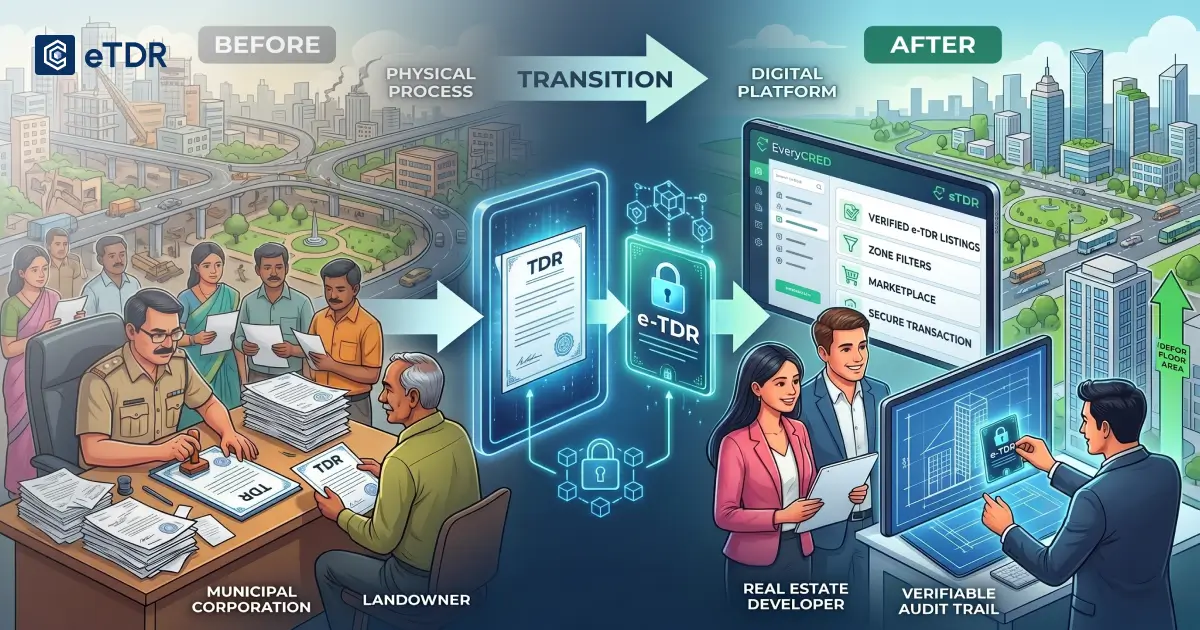
Most Indian cities still manage TDR through physical certificates, manual registers, and in-person file checks. Every stage in that process creates a gap in the record. Municipal officers, developers, landowners, and regulators each hold a fragment of the information. A digital TDR system replaces those fragments with one shared, live record that every authorised party can access at any point.

Why India’s TDR Process Fails on Transparency Before a Single Certificate Gets Forged

The information gap in TDR is structural. It comes from the paper medium itself, not from individual administrative failures.

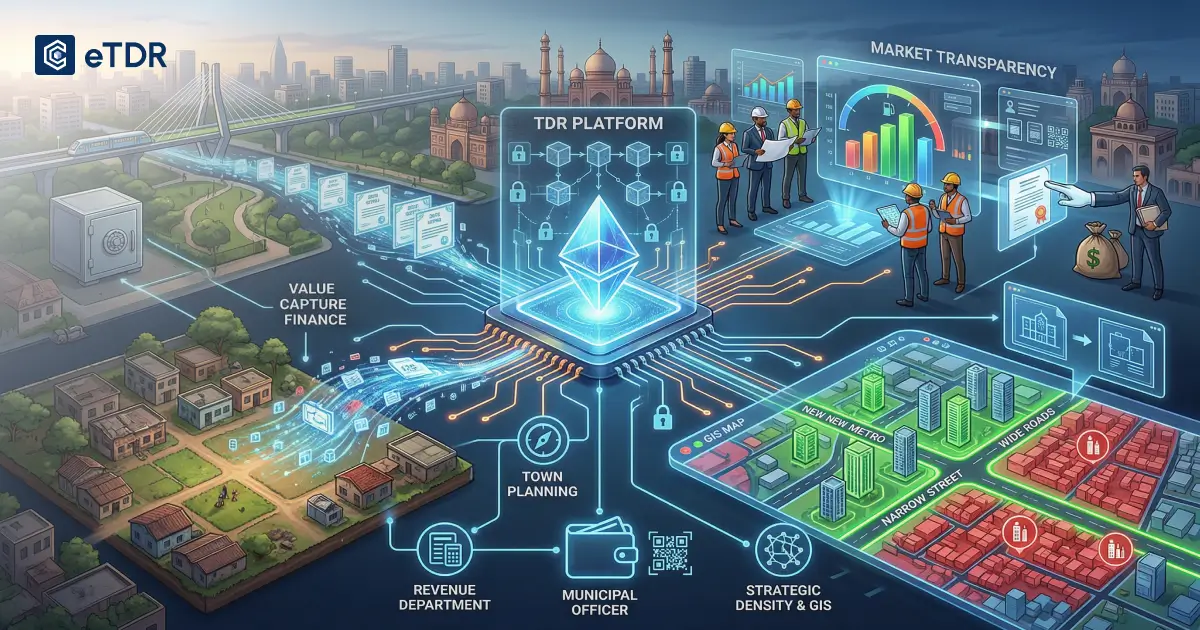
  • The town planning department issues a TDR certificate. The revenue department holds the ownership record. The building permissions department reviews it at the point of use. None of these departments share a live data connection.
  • Transfers happen through broker networks. No published transaction price data exists anywhere in the system.
  • Verification requires office visits. A bank, court, or planning authority cannot confirm a certificate’s current status without a physical file check.
  • City planners have no real-time view of total TDR in circulation or which receiving zones are approaching FSI limits.

Sound TDR management at the city scale requires a shared, live record system. Paper registers do not provide this.

The Six Points in the TDR Lifecycle Where Information Disappears

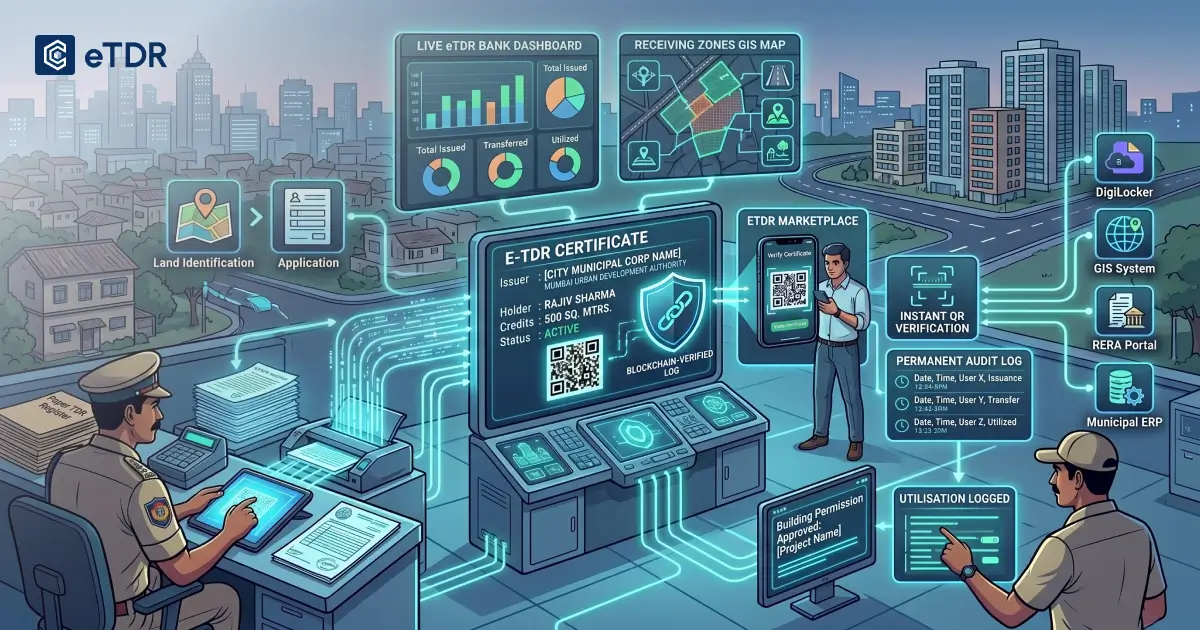
A TDR certificate moves through six stages: land identification, application, verification, issuance, transfer, and utilisation. In a paper system, information gaps enter at each one.

  1. Issuance: No shared digital record exists between departments. Each holds its own version of the same event.
  2. Transfer: Certificates move through intermediaries. The issuing authority is often unaware of subsequent transfers.
  3. Pricing: No public transaction data exists. Buyers and sellers work with privately shared information.
  4. Utilisation: When TDR is used to unlock additional FSI at the building approval stage, no automatic link exists back to the issuing authority’s records.
  5. Verification: Courts, banks, and planning bodies cannot confirm a certificate’s status without manual file retrieval. Instant digital verification of TDR certificates is only possible when a digital record exists in the first place.
  6. Audit: RTI applicants and CAG auditors requesting a full account of issuance, transfer, and utilisation cannot get one from a manual register.

What a Digital TDR System Puts Back Into the Record

An e-TDR platform replaces the fragmented paper trail with a single authoritative record. The Development Rights Certificate management process shifts from a multi-department paper exercise into a single digital workflow.

Here is what a digital TDR system changes at each stage:

  • Issuance: Each certificate is issued as a blockchain-anchored digital credential. The record cannot be altered after issuance.
  • Transfer: Every transfer is logged with a timestamp, actor identity, and reference to the original certificate. Ownership history is complete and permanent.
  • Pricing: Transaction data on a regulated platform creates pricing benchmarks visible to all market participants.
  • Utilisation: Building permits and TDR records exist within the same system. Every utilisation connects back to the issuing authority automatically.
  • Verification: Any authorised party can verify a certificate instantly using a QR code or unique certificate ID. No office visit is required.
  • Audit: Every officer action, every approval, and every transfer is logged on the blockchain. The record is immutable and immediately available for compliance review.

The full e-TDR lifecycle becomes traceable from land identification to final utilisation in a single system.

What Commissioners and Urban Planners Can Finally See in Real Time

In a paper TDR system, a city commissioner asking “how much TDR is currently in circulation?” cannot get an accurate answer without days of manual reconciliation across multiple departments. A digital TDR system produces this data immediately.

What municipal corporations and urban development authorities gain:

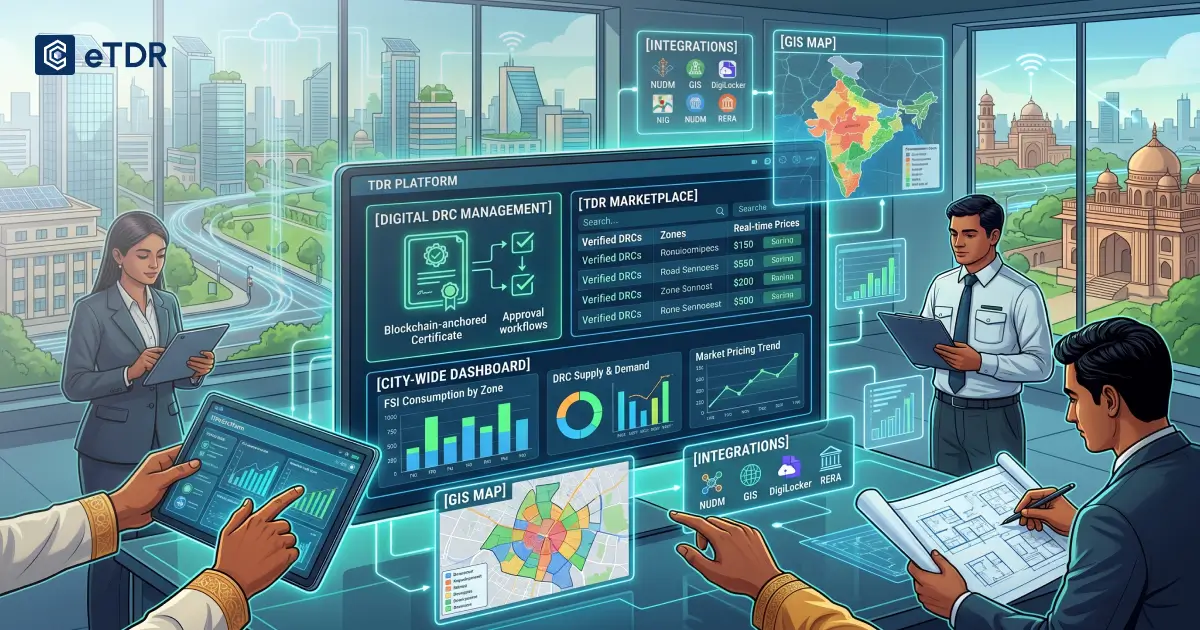
  • A live dashboard showing total TDR issued, transferred, in active use, and expired across the entire city.
  • Zone-level data showing which receiving areas are absorbing high TDR volume against infrastructure capacity.
  • A complete, timestamped audit log for every certificate, every officer action, and every approval at each workflow stage.
  • RTI and CAG-ready records that require no manual preparation before submission.
  • Multi-level approval visibility from junior engineer through to commissioner, with e-signatures at every step.

For Smart City Mission teams, this smart city alignment between TDR administration and digital governance standards is directly relevant. The National Urban Digital Mission requires Urban Local Bodies to meet open data and interoperability standards. A digital TDR system produces structured, timestamped data that satisfies these requirements from within the normal workflow.

Why Real Estate Developers Are Paying More Than They Should for TDR

The World Bank has identified transparent, liquid TDR markets as essential for the instrument to function as effective urban infrastructure finance. That transparency does not currently exist when transactions are brokered privately and price data remains undisclosed.

Developers operating in opaque TDR markets face three direct costs:

  • Information asymmetry: Sellers and buyers do not have equal access to pricing data. Intermediaries capture the gap.
  • Verification risk: A developer cannot confirm a certificate’s authenticity before purchase without visiting a municipal office, which adds time and cost to every transaction.
  • Approval delays: Manual TDR verification at the building permission stage delays project timelines.

A digital TDR system creates a structured market with visibility for all participants. An online TDR marketplace lists available e-TDR certificates with verified details, published transaction records, and direct transfer on a regulated platform. Certificate availability, pricing, and transfer happen with a complete record of every transaction. Developers reduce dependence on intermediaries and submit e-TDR credentials directly at the building permission stage.

How e-TDR Makes Regulatory Compliance a Built-In Process

In a paper TDR system, regulatory compliance requires collecting records from multiple departments and reconciling them manually. A digital TDR system produces compliance as a standard output of the issuance and transfer workflow.

  • RERA filings that require TDR documentation are supported by verified digital credentials that match the project record directly.
  • Court proceedings involving disputed certificates have access to an immutable blockchain record with complete provenance history.
  • The approval chain from initial application to final issuance is logged at every stage. No reconstruction of records is needed for a legal dispute or regulatory inquiry.
  • Inter-city and inter-state verification becomes possible because e-TDR certificates issued on standardised platforms can be verified by any authorised authority.

This is the practical governance outcome of a complete digital TDR system: every action that matters is recorded, verifiable, and permanently available to the parties who need it.

EveryCRED eTDR is for the Accountability Standard Indian Cities Need

Municipal corporations and urban development authorities managing TDR through paper records carry structural transparency gaps that staffing and process improvements cannot resolve. We built the EveryCRED eTDR platform to close these gaps at the system level.

The platform issues tamper-proof TDR certificates as blockchain-anchored verifiable credentials, tracks every transfer with a permanent audit trail, and gives commissioners and town planners a live eTDR Bank dashboard across all city zones. Multi-level approval workflows, e-signatures at every stage, QR-based instant verification, and a regulated eTDR marketplace are all part of a single government-grade system. Alignment with DigiLocker, RERA portals, GIS systems, and municipal ERP software means EveryCRED eTDR works within the infrastructure cities already use.

If your city is ready to move TDR administration from paper registers to a fully auditable digital record, speak with our team to understand what implementation looks like for your jurisdiction.

Conclusion

Transparency in TDR is what makes the instrument function as intended. When issuance, transfer, pricing, and utilisation are visible to the right parties at the right time, TDR works as a reliable land acquisition tool that both governments and developers can trust. A digital TDR system is the infrastructure that makes this possible. Cities that adopt it gain not just efficiency but the kind of documented accountability that paper records cannot provide.
TDR Investment in Real Estate: What India’s Developers and Cities Are Getting Right Now

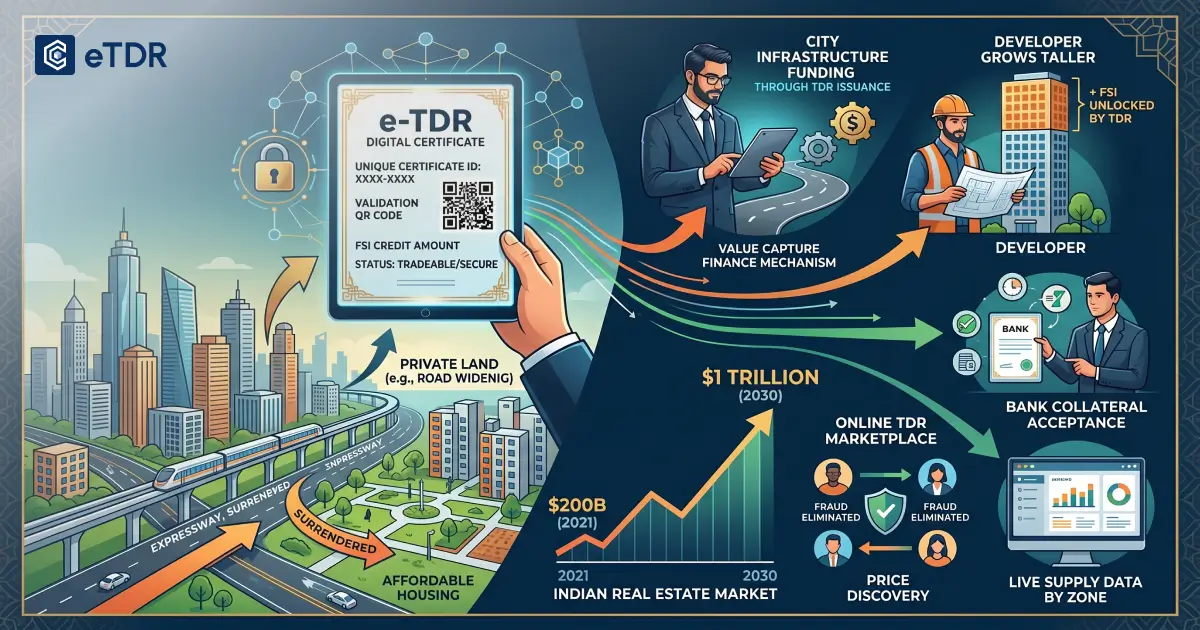
India’s cities are acquiring private land at a pace that the old paper-based system cannot sustain. Road widening, public parks, drainage corridors, and affordable housing projects all require land. Municipal corporations issue Transferable Development Rights certificates to compensate landowners instead of making cash payments. Those certificates carry real monetary value. They can unlock additional floor space on a receiving plot or be sold to a real estate developer.

TDR investment has moved well beyond its origins as a planning workaround. In cities like Mumbai, Hyderabad, Pune, and Ahmedabad, it operates as a structured market instrument. Developers buy TDR to expand project scale. Landowners hold Development Rights Certificates (DRCs) as income-generating assets. Cities use TDR issuance to finance infrastructure without depleting their budgets.

Here, we have covered the investment case for TDR, the factors that determine its value, the risks that have held the market back, and how e-TDR infrastructure is changing those conditions.

Why TDR Has Earned Its Place as a Serious Investment Instrument

TDR is not speculative. It is a government-issued certificate backed by surrendered land with a defined FSI credit attached to it. The Ministry of Housing and Urban Affairs placed TDR inside its Value Capture Finance Policy Framework in 2017, recognising it as one of ten approved mechanisms for urban bodies to manage infrastructure financing. That government endorsement gives TDR investment a legitimacy that most alternative real estate instruments do not carry.

The World Bank has documented TDR’s role as a value capture tool suited specifically to fast-urbanising economies where municipal budgets are under pressure. The instrument allows cities to acquire land without cash outflow while simultaneously creating a tradeable asset in the private market.

India’s real estate sector is projected to reach $1 trillion by 2030, up from $200 billion in 2021. TDR is not a parallel mechanism to that growth. It is embedded inside it — it funds the infrastructure that makes urban density possible.

What Actually Determines the Value of a TDR Certificate

TDR pricing is not arbitrary. It follows specific, measurable factors. Any serious TDR investment decision must account for these.

Receiving zone location

A TDR certificate can only be used in designated receiving areas. Zones near metro corridors, IT clusters, and business districts attract higher developer demand. Higher demand pushes TDR prices up in those areas.

FSI scarcity in the receiving zone

Where base FSI limits are tightly controlled, developers have a stronger need for TDR to unlock additional buildable area. That regulatory scarcity is a direct support for price.

Infrastructure investment nearby

New expressways, metro extensions, and greenfield airports in peripheral zones increase developer activity in those areas. TDR applicable to those receiving zones appreciates alongside the infrastructure investment.

Active supply in the market

Cities that track total TDR issued, utilised, and available give investors a clear picture of supply. Cities that do not track this data leave investors making decisions on incomplete information.

Urban redevelopment pipelines

Colliers India’s 2026 real estate outlook identifies TDR frameworks as a key driver of urban redevelopment in Mumbai, Delhi NCR, Bengaluru, and Chennai. As older buildings in dense zones are redeveloped, TDR demand in eligible receiving zones increases directly.

The Risks That Have Kept TDR Investment from Reaching Its Potential

TDR investment carries documented risks. Understanding them is essential before committing capital.

The NITI Aayog TDR Guidelines explicitly acknowledge two core investor concerns: monetary value uncertainty tied to overall property market conditions, and liquidity risk when a DRC holder needs to exit but cannot locate a buyer quickly.

Physical DRCs add a third problem. Forged certificates have been submitted in multiple building approvals in Indian cities, creating legal exposure for buyers who paid full market price for fraudulent documents.

Additional risks include:

  • Zone mismatch: A receiving plot outside the eligible zone makes the TDR certificate unusable there. The purchase price is effectively lost.
  • Broker-controlled pricing: Without a transparent market, sellers receive below-market rates and buyers overpay. Neither party has access to historical transaction data.
  • No central supply registry: In most cities, there is no way to confirm in real time how many certificates are active, transferred, or already utilised.
  • Manual verification delays: Cross-checking paper DRCs at the building approval stage adds weeks to project timelines and creates financial exposure.

Proper certificate verification is a non-negotiable step in any TDR purchase. Without it, the investment carries legal risk that cannot be quantified after the fact.

How the Shift to e-TDR Changes the Investment Math

Each of the above risks has a direct solution in a digital TDR system. The shift from paper to e-TDR does not just improve administration. It changes the fundamental conditions that determine whether TDR investment is viable.

Fraud is structurally eliminated

A blockchain-anchored e-TDR certificate cannot be duplicated or forged. Its unique identifier is permanently recorded. Any attempt to use a consumed certificate is blocked automatically at the system level.

Price discovery replaces broker dependency

The move toward an online TDR marketplace gives both buyers and sellers access to the same supply data and transaction history. The information advantage that brokers have held is removed.

Banks can assess TDR as collateral

A QR code or unique certificate ID confirms authenticity in seconds. Banks no longer need weeks of manual verification to process TDR-backed applications. This opens TDR investment to leveraged acquisition structures for the first time in most cities.

Landowners can exit without intermediaries

Selling TDR rights through a digital platform means the holder does not need a broker to locate a buyer or complete a transfer. Ownership changes in minutes through the platform.

Developers get live supply data before committing

Smart city TDR systems give developers, planners, and institutional buyers real-time visibility into TDR volumes by zone. Investment decisions are made on verified supply data rather than broker estimates.

Who Should Be Thinking About TDR Investment Right Now

TDR investment works differently depending on the stakeholder. The opportunity is real for each of the following groups, though the logic differs.

Real estate developers

Developers buying TDR to unlock FSI gain buildable area at a cost consistently lower than acquiring equivalent land. In constrained urban zones, that additional area directly affects project margins, unit count, and approval speed. TDR investment at the right stage of a project is a cost management decision as much as a planning one.

Landowners holding DRCs

A verified, digitally issued TDR certificate is a liquid asset. Holding it means holding government-backed FSI credit that appreciates as demand rises in the receiving zone. The exit is straightforward through a digital marketplace, without dependence on a single buyer.

Municipal corporations and urban development authorities

Every TDR transaction represents land acquired, a public project enabled, and a certificate monetised through private capital. Cities that manage TDR well attract higher developer participation, which in turn finances more infrastructure. TDR investment by developers is the mechanism through which city infrastructure gets funded without placing the full burden on the municipal budget.

Banks and financial institutions

A digitally issued e-TDR certificate, backed by blockchain and carrying a verifiable audit trail, addresses the primary lender concern: authenticity. Banks gain the ability to process TDR-backed financing without the delays and uncertainty that paper certificates introduce.

EveryCRED eTDR Is the Best Solution for the TDR Investment Market India Needs

The investment case for TDR is clear. The barrier has always been execution: verifying certificates, tracking ownership, and accessing a transparent market where buyers and sellers can transact with confidence.

We built EveryCRED eTDR to address these problems directly, for municipal corporations, developers, landowners, and financial institutions. The platform issues blockchain-anchored e-TDR certificates with multi-level approval workflows and automatic tamper-proof recording. Every certificate carries a unique ID and QR code for instant verification by any authorised party.

We connect all stakeholders on a single auditable platform: issuers, holders, buyers, and verifiers. The eTDR Bank gives city administrators live data on total TDR issued, available, utilised, and blocked across all zones. The eTDR Marketplace lets verified holders list certificates and developers purchase them with full compliance checks in place.

The platform is aligned with RERA, DigiLocker, GIS systems, and Smart City Mission mandates. It operates on W3C Verifiable Credentials standards, making e-TDR certificates issued by one municipal body verifiable by any other authority.

If your city, development authority, or organisation is ready to make TDR investment credible and traceable, connect with our team to see the platform in action.

Conclusion

TDR has always carried genuine investment value. What has limited its adoption is the absence of reliable infrastructure to issue, verify, and trade certificates at scale. As India’s urban development cycle accelerates and land acquisition pressure grows across every major city, TDR investment is becoming a practical strategy for developers, landowners, and urban authorities. The transition to e-TDR is the critical enabler of that shift — turning a paper-based administrative process into a transparent, bankable, and credible asset class.

Smart City TDR Platform Explained: What India’s Urban Planners and Developers Need to Know

India’s cities are building roads, parks, drainage systems, and public infrastructure at a pace that demands a faster approach to land acquisition. The Smart Cities Mission has pushed 100 cities toward technology-led urban administration. The National Urban Digital Mission is extending digital infrastructure to over 4,800 urban local bodies. Land records are being digitised at the national level through DILRMP. 

Yet Transferable Development Rights, one of the most widely used tools for government land acquisition, still runs on paper in most Indian cities. That gap matters. A dedicated smart city TDR platform is what bridges it. 

TDR Is Still Failing Cities That Have Gone Digital 

City governments have successfully digitised property tax, water billing, and grievance systems. TDR management has not kept pace. The consequences show up across every stakeholder in the process. 

Development Rights Certificates (DRCs) issued on paper can be forged, duplicated, and sold to multiple buyers. Pricing is set privately through broker networks with no public visibility. Municipal officers verify TDR holdings by cross-checking physical files, a task that can take days or weeks. City planners have no reliable data on how much TDR has been issued, transferred, or consumed across zones. 

These are not administrative inefficiencies that better staff management can fix. They are structural failures that slow infrastructure delivery, distort land markets, and reduce public trust in the urban planning process. 

Understanding what TDR is makes it immediately clear why managing it digitally is not optional for cities with serious infrastructure pipelines. 

What “Smart City Ready” Actually Means for a TDR Platform 

A smart city TDR platform is not a scanned version of a paper process. It is a live, connected system that gives every participant in the TDR ecosystem, from the issuing officer to the developer using DRCs in a building approval, accurate information at the right moment. 

A platform qualifies as smart city-ready when it does the following: 

  • Issue DRCs digitally with multi-level approval workflows and e-signatures at each stage 
  • Anchors every certificate on blockchain, making records tamper-proof and permanently traceable 
  • Operates a regulated digital marketplace where landowners and developers transact directly 
  • Automates TDR verification during building approvals, including zone eligibility checks and utilisation deductions 
  • Provides real-time dashboards showing DRC supply, market pricing, and FSI consumption by zone 
  • Integrates with GIS systems, RERA portals, DigiLocker, and municipal ERP software 
  • Supports inter-city and inter-state certificate recognition, so a DRC issued by one authority is verifiable by another 

How this works in practice across the roles of issuer, seller, and buyer follows a structured and fully auditable sequence on a well-built e-TDR system. 

The Four Groups That a TDR Platform Must Actually Serve 

Every TDR transaction involves multiple parties. A platform built for only one of them creates friction for the others. 

  1. Municipal Corporations and Urban Development Authorities

These bodies issue DRCs when landowners surrender land for public projects. On a smart city TDR platform: 

  • Issuance is digital, with automatic blockchain anchoring on final approval 
  • Every action, from land identification to certificate issuance, is timestamped and auditable 
  • A central dashboard gives administrators a live view of all issued, active, transferred, and utilised TDR in the city 

Cities managing digital TDR at scale gain direct operational control over the DRC lifecycle without relying on manual registers or physical files. 

  1. Smart City Mission Teams

Urban planning teams need reliable data to make decisions on density, zoning, and infrastructure investment. A smart city TDR platform gives them: 

  • Zone-level DRC supply and demand visibility 
  • Historical and current market pricing by receiving zone 
  • FSI consumption data broken down by area and approval type 
  • Early signals on which zones face supply shortfalls 
  1. Real Estate Developers

Developers need TDR to increase FSI on their projects. On a digital marketplace, they can browse verified DRC listings by zone and area, purchase directly without broker involvement, and receive automatic TDR verification during building plan submissions. 

For a clear explanation of how to access and transact on the market, selling TDR online follows a structured process that removes the pricing opacity and delays that defined the paper-based system. 

  1. Landowners

Landowners who surrender land receive DRCs as compensation. On an e-TDR platform, they list certificates directly, set an asking price, and track offers in real time, without depending on brokers or navigating informal markets. 

India’s Digital Governance Framework Already Points Here 

The policy environment in India is designed to support this kind of platform. 

The National Urban Digital Mission (NUDM), launched in 2021 by the Ministry of Housing and Urban Affairs, aims to build shared digital infrastructure across all urban local bodies. It promotes open, interoperable platforms for municipal services, from property tax to building approvals, working across three pillars: people, process, and platforms. 

A smart city TDR platform built on open standards connects directly to this infrastructure. It integrates with the same tools cities are already building: Aadhaar-linked identity, DigiLocker for verified document access, and RERA for real estate compliance. The technical architecture of an end-to-end e-TDR platform is designed to fit within this national digital stack, not sit outside it. 

The Data Layer Is What Changes Urban Planning Decisions 

The most important feature of an e-TDR platform is not the transaction system. It is the data that the platform generates. 

When TDR runs on paper, planning departments have no reliable aggregate view of the market. Decisions on zoning, density, and infrastructure budgeting happen without knowing how much TDR has been issued, where it is concentrated, or at what prices it is trading. 

On a smart city TDR platform, planning teams can access: 

  • Total DRC area issued versus total utilised, citywide and by zone 
  • Current market pricing trends for TDR across receiving zones 
  • Which zones face supply shortfalls relative to development demand 
  • The rate at which issued certificates are moving through the market into building approvals 

This data directly supports decisions on where to allow higher density, how much infrastructure the city can fund through TDR, and whether the current policy is producing its intended outcomes. Understanding e-TDR as a connected system, rather than a certificate format, clarifies why the data layer is as important as the transaction layer. 

EveryCRED eTDR is Built for Cities That Need This to Work 

We built the EveryCRED e-TDR platform for Municipal Corporations, Urban Development Authorities, and Smart City Mission teams that are ready to run a live digital TDR program, not a pilot. 

Here is what the platform delivers: 

  • Full DRC lifecycle management from issuance through transfer, utilisation, and verification 
  • Blockchain-backed certificates built on W3C Verifiable Credentials, ensuring records that cannot be altered or duplicated 
  • A regulated digital marketplace where DRC holders and developers transact directly, with full pricing transparency 
  • Automated building approval integration for real-time TDR verification, reducing approval timelines from weeks to seconds 
  • Real-time dashboards for administrators and planning officials, covering supply, demand, pricing, and FSI consumption 
  • Integration with DigiLocker, RERA, GIS systems, and existing municipal ERPs 
  • Inter-city and inter-state interoperability, so a DRC issued by one authority is accepted by another 
  • Multi-level approval workflows with e-signatures, from Junior Engineer to Commissioner 

We configure the platform to your city’s regulatory framework, zone structure, and existing workflows. No new IT department. No system overhaul. Your team brings the mandate. We bring the platform. 

If your organisation is currently managing TDR through paper certificates, manual registries, or disconnected systems, reach out to us. We will walk you through what a fully operational smart city TDR program looks like in practice. 

Conclusion 

India has the policy direction, the digital infrastructure, and the governance mandate to transform how cities manage Transferable Development Rights. The Smart Cities Mission, NUDM, and DILRMP have established the foundation. What has been missing is a purpose-built smart city TDR platform that connects issuance, trading, verification, and planning data into a single, auditable system. 

That platform exists. The question now is adoption. Mumbai has already adopted it. 

Cities that digitise TDR management gain faster land acquisition, fraud-proof certificates, transparent DRC markets, and the planning data they need to make better decisions. Those that continue on paper will continue to face the same delays, disputes, and opacity that have limited TDR’s effectiveness for decades. 

India’s Urban Infrastructure Is Shifting to an Online TDR Marketplace

Urban expansion requires continuous land acquisition. Local governments must acquire privately owned land to build roads, parks, and public facilities. Paying cash compensation often strains municipal budgets. Authorities issue Transferable Development Rights (TDR) to solve this problem. These rights function as alternative compensation. They allow property owners to build additional floor space on their remaining property. Owners can also sell these rights to real estate developers. 

The traditional management system relies entirely on physical paper certificates. This manual process creates long delays. It complicates verification procedures for municipal staff. It also exposes the system to forgery and lost documents. An online TDR marketplace changes this administrative process. It converts physical certificates into digital e-TDR units. This dedicated platform connects municipal corporations directly with real estate developers. The digital environment removes the need for physical intermediaries. It standardizes the trading process across different urban zones. 

The Anatomy of a Digital Land Rights Exchange 

An online TDR marketplace functions as a central registry and a secure trading platform. It removes physical paperwork from the land acquisition and real estate development process. The system operates on direct digital inputs and automated verifications. 

  • Certificate Generation: Municipal authorities complete the physical land acquisition. Authorized officials log into the portal. They enter the specific land dimensions and zone categories. The system automatically generates the digital development rights. 
  • Asset Listing: Landowners receive access to their digital accounts. They view their verified development rights. They list their available rights on the public portal for prospective buyers to review. 
  • Market Discovery: Real estate developers need additional floor space index for their projects. They access the online TDR marketplace. They filter available rights by zone, size, and price. Developers evaluate the fundamental variations in building allowances to ensure the rights apply to their specific project zones. 
  • Transaction Execution: The buyer and seller agree on the terms. They execute the transfer through the platform. The system updates the central registry immediately to reflect the new ownership. 

The Lifecycle of a Digital Right from Generation to Consumption 

Understanding the exact movement of an e-TDR clarifies the system’s efficiency. The process follows a strict linear path defined by municipal regulations. 

  • Initiation: The property owner surrenders land to the Urban Development Authority. The authority signs the physical surrender documents. 
  • Digitization: The municipal clerk inputs the surrender data into the database. The system issues the e-TDR to the citizen’s digital wallet. 
  • Holding Period: The citizen holds the digital asset securely. The asset cannot degrade or face destruction like a physical paper document. 
  • Transfer: A real estate developer purchases the right. The ownership transfers in the digital ledger. The original owner no longer has access to the digital asset. 
  • Utilization: The developer applies for building permissions. The developer submits the digital certificate to the municipal corporation to expand their building parameters. 
  • Retirement: The municipal corporation approves the building plan. The system marks the e-TDR as consumed. The asset is permanently retired and removed from public circulation. 

Municipal Corporations Standardize Land Acquisition 

Local governments face severe challenges in tracking physical development certificates. An online TDR marketplace provides Smart City Mission Teams and municipal bodies with real-time administrative oversight. 

  • Centralized Tracking: City planners monitor the exact volume of development rights issued across all city zones. They track how many rights actively circulate in the market at any given time. 
  • Fraud Prevention: Physical certificates allow for illicit duplicate submissions. Digital ledgers verify the unique identifier of every e-TDR. The system automatically blocks any attempt to reuse a consumed certificate. 
  • Value Capture Integration: The national guidelines on urban development funding from NITI Aayog emphasize using these rights for infrastructure financing. Digitization makes this financing method accountable and measurable for government auditors. 
  • Smart City Mandates: Implementing a digital infrastructure framework aligns local governance with national technology directives. It creates a data-driven environment for urban planning. 

This shift enables municipal bodies to manage urban density with exact precision. They rely on concrete data rather than manual estimations. 

Real Estate Developers Secure Verified Approvals 

Developers require reliable sources for additional building rights to maximize their project scale. The physical certificate system involves manual verification steps that delay project timelines by months. 

  • Instant Verification: Developers check the authenticity of a certificate instantly on the platform. The system queries the municipal database to confirm the asset remains valid and unconsumed. 
  • Direct Procurement: Buyers negotiate and purchase directly from verified sellers. The online TDR marketplace eliminates unregulated brokers and opaque pricing structures from the procurement process. 
  • Project Certainty: Clear visibility into available rights allows developers to plan high-density commercial and residential projects with total certainty. They secure the exact square footage required before beginning construction. 
  • Approval Efficiency: The operational advantages for city planning extend directly to private developers. Verified digital certificates move through the building approval process faster than physical documents. 

An online TDR marketplace creates a highly predictable procurement cycle for real estate firms operating in dense urban centers. 

Transitioning Physical Assets to Digital Formats 

Paper certificates deteriorate over time. They get lost in municipal archives. They face constant counterfeiting risks. Converting these physical documents into an e-TDR format secures the municipal asset base. 

  • Data Migration: Administrative teams input existing physical certificate details into the new municipal database. They scan the original documents for the permanent archive. 
  • Owner Authentication: The system verifies the identity of the original land owner using national identity databases. This ensures the digital asset goes to the correct legal entity. 
  • Digital Issuance: The platform generates a secure digital asset. It links this unit directly to the authenticated owner’s profile. 
  • National Standardization: The Ministry of Housing and Urban Affairs drives the push for digitization in urban infrastructure to standardize land records across all states. 

This structured conversion process addresses the immediate requirement for Indian municipalities to audit and secure their historical land records. 

Infrastructure Requirements for the Trading Portal 

Building a functional online TDR marketplace requires specific technical foundations. The software must handle highly sensitive government data. It must also process high-value financial transactions without failure. 

  • Role-Based Access: The system requires distinct login protocols. Government officials, landowners, and developers require different permission levels within the portal to maintain security. 
  • Immutable Ledgers: A verifiable registry tracks every single change in ownership. Once a transaction occurs, the record cannot undergo alteration or deletion by any user. 
  • Automated Zoning Calculations: The platform calculates the exact square footage available based on complex, zone-specific municipal regulations. 
  • Secure Data Transfers: Implementing a standardized electronic transfer protocol ensures complete data integrity during the handover between buyer and seller. 

The technical architecture supports concurrent users during high-demand periods. It maintains uptime during peak real estate transaction seasons. 

Implementing Verifiable Digital Infrastructure 

EveryCRED eTDR provides a verifiable credential system for municipal corporations and urban development authorities. Our platform digitizes paper certificates into cryptographically secure e-TDR units. It establishes an online TDR marketplace where real estate developers verify and acquire rights directly.  

EveryCRED integrates with existing municipal databases to track the generation, transfer, and consumption of development rights in real time. The system prevents duplicate usage. It maintains a clear, automated audit trail for government oversight. Municipalities use this system to transition away from physical document management and establish strict control over their development rights inventory. 

Contact us now for a demo. 

The Future of Urban Density Management 

Indian cities require efficient land acquisition methods to build the necessary public infrastructure. Transferable Development Rights facilitate this process without depleting municipal funds. Moving this system to an online TDR marketplace eliminates manual errors. It accelerates real estate approvals.  

Urban planners maintain exact records of urban density and land use. Real estate developers access the building rights they need without administrative delays. Digitizing these assets into e-TDR formats creates a functional and transparent environment for organized city growth. The transition from paper to digital platforms secures the integrity of urban development across the country. 

Benefits of Using a TDR Platform in Urban Planning & Development

India faces rapid urbanization. Municipal Corporations and Urban Development Authorities must acquire private land to build roads, parks, and public infrastructure. Paying cash for this land drains municipal budgets.  

To solve this, the government issues Transferable Development Rights (TDR) to compensate landowners. The landowner can sell these rights to a real estate developer. The developer then uses the rights to build taller structures or increase the Floor Space Index on another plot of land. 

The traditional paper process for managing these rights is slow and prone to errors. A digital TDR platform solves these administrative problems. It creates a secure digital record for every transaction. This transformation benefits municipal authorities, smart city planners, and real estate developers. 

The Shift to Value-Capture Finance in City Planning 

Funding Infrastructure Without Cash Payouts 

Municipalities lack the necessary cash reserves to buy private land for large public infrastructure projects. 

  • It allows the city to acquire land without spending public funds. 
  • Authorities issue a digital certificate to the landowner based on the exact square footage of the surrendered land. 
  • The landowner receives financial compensation by selling the certificate in the open market to private builders. 

Easing the Burden on Public Treasuries 

The system shifts the cost of public infrastructure development to the private real estate sector. 

  • Government funds remain available for essential civic services like water supply and sanitation. 
  • The digital system tracks the specific volume of land acquired by the city. 
  • It simultaneously records the corresponding development rights issued to the public. 
  • This creates a balanced ledger that proves the municipal corporation received the land before issuing the rights. 

Eradicating the Blind Market for Developers 

Transparent Supply and Demand Metrics 

The traditional paper system creates a blind market for buyers and sellers. Developers cannot easily determine the available supply of development rights in the city. 

  • Private brokers often hoard paper certificates to artificially inflate market prices. 
  • A central TDR platform displays the total volume of available rights to all authorized participants. 
  • Builders can forecast their project costs accurately because they can view historical transaction data and current market availability. 

Accelerated Project Approvals 

Real estate developers require predictable timelines to secure funding and complete construction projects. 

  • Paper certificates require manual verification across multiple municipal departments. This process often takes several months. 
  • An e-TDR system verifies the digital certificate instantly through a secure central database. 
  • The automated verification process allows developers to secure their final building permissions much faster. 

Securing Land Rights Against Fraud and Duplication 

The Problem with Paper Certificates 

Paper Development Rights Certificates are vulnerable to physical damage and loss. They also present severe security risks for the municipal corporation. 

  • Malicious actors forge paper documents to sell the same rights to multiple developers. 
  • Municipal clerks struggle to detect sophisticated document forgeries during routine manual inspections. 
  • A single fraudulent certificate can halt a major real estate project and lead to years of legal disputes. 
  • Replacing a lost paper certificate requires a lengthy legal process involving police reports and public notices. 

Establishing a Single Source of Truth 

A TDR platform relies on cryptographic security to issue verifiable digital credentials to landowners. 

  • The system records every issuance and subsequent transfer on an immutable digital ledger. 
  • This technology provides end-to-end traceability from the exact moment the city issues the e-TDR to the moment the developer consumes it. 
  • The platform automatically rejects any attempt to spend the same development right twice. 
  • Banks and financial institutions can verify the authenticity of an e-TDR instantly before accepting it as collateral for a construction loan. 

Directing Density to High-Capacity Corridors 

Strategic FSI Allocation 

Urban Development Authorities must control where real estate developers build high-density projects. The city infrastructure must support the increased population. 

  • A digital TDR platform categorizes city zones based on current infrastructure capacity. 
  • The system actively restricts the use of an e-TDR in neighborhoods with narrow roads or inadequate water supply. 
  • Planners configure the software to incentivize the use of these rights along new transit corridors and wide arterial roads. 
  • This mechanism prevents unchecked urban sprawl and aligns private construction with the official city master plan. 

GIS Integration for Zoning Compliance 

Modern digital platforms integrate directly with Geographic Information Systems. This provides a visual interface for city engineers. 

  • Planners view a live digital map showing exactly where developers apply their purchased development rights. 
  • This integration acts as a reliable urban planning tool to maintain balanced city growth. 
  • The software calculates the maximum allowable Floor Space Index for a specific plot based on local zoning laws. 
  • The platform automatically blocks any transfer or utilization request that violates the established density limits of a specific ward. 

Modernize Municipal Workflows with EveryCRED eTDR 

Municipal Corporations require secure technology to manage complex land transactions. EveryCRED eTDR provides a compliant TDR platform designed specifically for government authorities and real estate developers. The platform replaces manual ledgers with verifiable digital certificates. 

The software connects the Town Planning department with the Revenue Department to ensure consistent data across all government offices. Municipal officers use the platform to issue an e-TDR directly to a citizen’s digital wallet. Real estate developers verify the authenticity of the e-TDR instantly via a unique digital ID or a QR code.  

This infrastructure integrates with existing municipal software programs. Authorities can modernize their approval workflows and establish a secure e-TDR market without disrupting their current daily operations. 

Conclusion 

Managing urban density requires precise data and secure administrative processes. Paper systems create significant delays and expose the government to constant fraud risks. A dedicated TDR platform gives Municipal Corporations complete operational control over land acquisition and development rights. It provides real estate developers with a transparent digital market to purchase the construction rights they need. Adopting an e-TDR system is a necessary and practical step for any city administration aiming to build efficient urban infrastructure.