How a Digital TDR System Fixes the Transparency Gap in India’s Urban Land Process

India issues TDR certificates to landowners who surrender private land for roads, parks, and public infrastructure. The NITI Aayog guidelines on TDR recognise it as a primary instrument under India’s Value Capture Finance framework. The policy has strong foundations. The administration supporting it does not.

Most Indian cities still manage TDR through physical certificates, manual registers, and in-person file checks. Every stage in that process creates a gap in the record. Municipal officers, developers, landowners, and regulators each hold a fragment of the information. A digital TDR system replaces those fragments with one shared, live record that every authorised party can access at any point.

Why India’s TDR Process Fails on Transparency Before a Single Certificate Gets Forged

The information gap in TDR is structural. It comes from the paper medium itself, not from individual administrative failures.

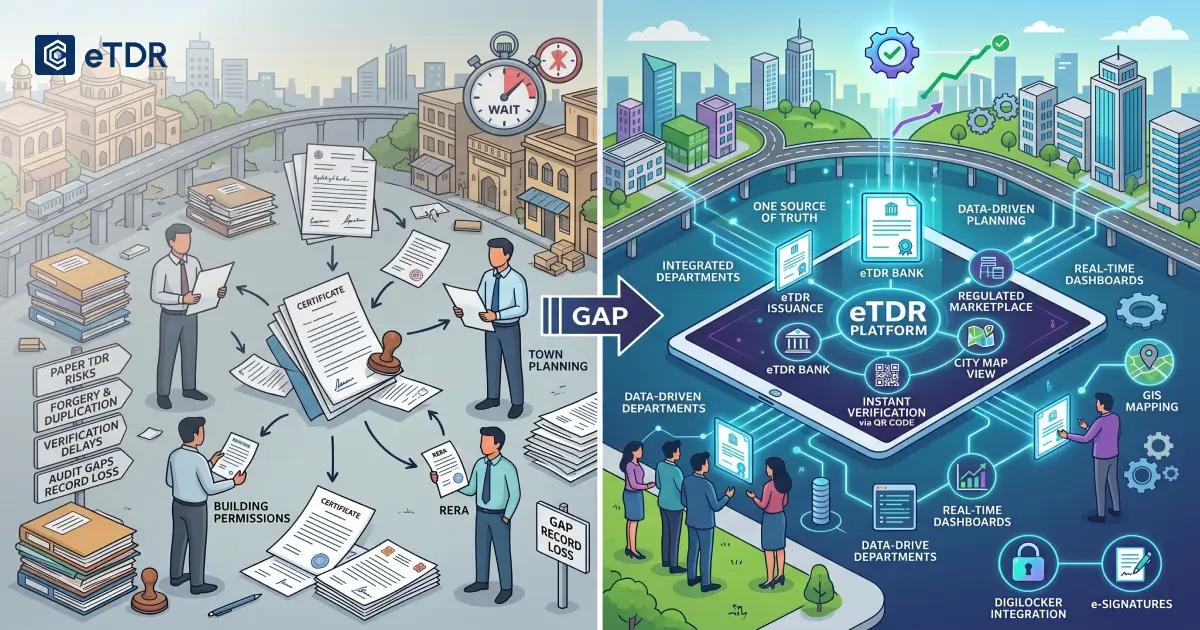
  • The town planning department issues a TDR certificate. The revenue department holds the ownership record. The building permissions department reviews it at the point of use. None of these departments share a live data connection.
  • Transfers happen through broker networks. No published transaction price data exists anywhere in the system.
  • Verification requires office visits. A bank, court, or planning authority cannot confirm a certificate’s current status without a physical file check.
  • City planners have no real-time view of total TDR in circulation or which receiving zones are approaching FSI limits.

Sound TDR management at the city scale requires a shared, live record system. Paper registers do not provide this.

The Six Points in the TDR Lifecycle Where Information Disappears

A TDR certificate moves through six stages: land identification, application, verification, issuance, transfer, and utilisation. In a paper system, information gaps enter at each one.

  1. Issuance: No shared digital record exists between departments. Each holds its own version of the same event.
  2. Transfer: Certificates move through intermediaries. The issuing authority is often unaware of subsequent transfers.
  3. Pricing: No public transaction data exists. Buyers and sellers work with privately shared information.
  4. Utilisation: When TDR is used to unlock additional FSI at the building approval stage, no automatic link exists back to the issuing authority’s records.
  5. Verification: Courts, banks, and planning bodies cannot confirm a certificate’s status without manual file retrieval. Instant digital verification of TDR certificates is only possible when a digital record exists in the first place.
  6. Audit: RTI applicants and CAG auditors requesting a full account of issuance, transfer, and utilisation cannot get one from a manual register.

What a Digital TDR System Puts Back Into the Record

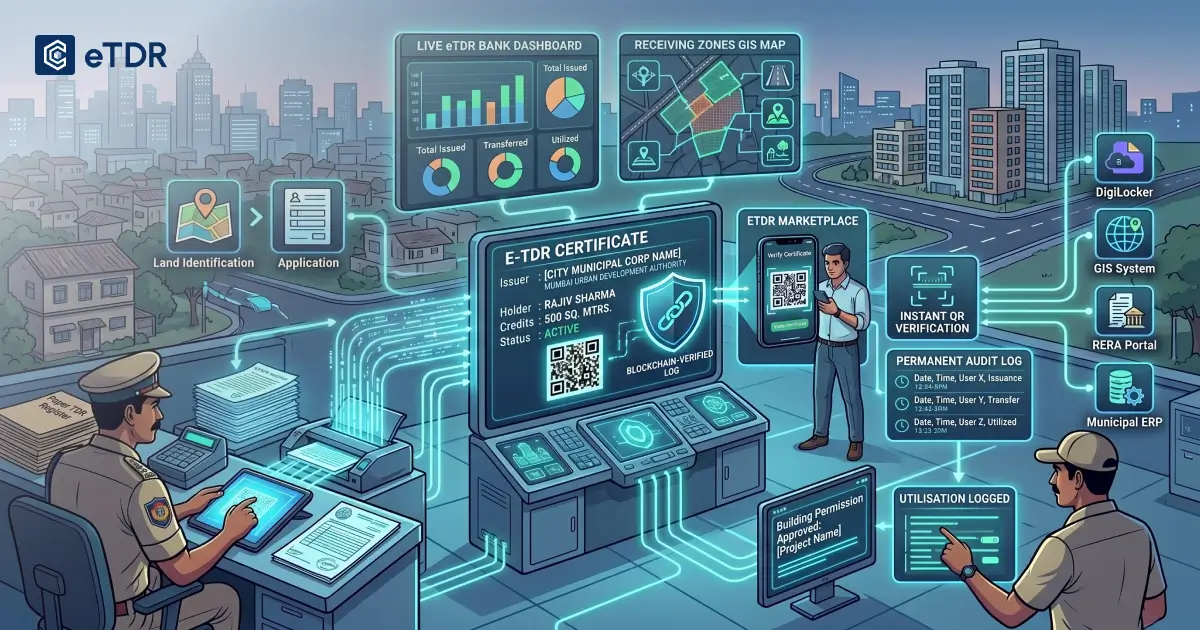
An e-TDR platform replaces the fragmented paper trail with a single authoritative record. The Development Rights Certificate management process shifts from a multi-department paper exercise into a single digital workflow.

Here is what a digital TDR system changes at each stage:

  • Issuance: Each certificate is issued as a blockchain-anchored digital credential. The record cannot be altered after issuance.
  • Transfer: Every transfer is logged with a timestamp, actor identity, and reference to the original certificate. Ownership history is complete and permanent.
  • Pricing: Transaction data on a regulated platform creates pricing benchmarks visible to all market participants.
  • Utilisation: Building permits and TDR records exist within the same system. Every utilisation connects back to the issuing authority automatically.
  • Verification: Any authorised party can verify a certificate instantly using a QR code or unique certificate ID. No office visit is required.
  • Audit: Every officer action, every approval, and every transfer is logged on the blockchain. The record is immutable and immediately available for compliance review.

The full e-TDR lifecycle becomes traceable from land identification to final utilisation in a single system.

What Commissioners and Urban Planners Can Finally See in Real Time

In a paper TDR system, a city commissioner asking “how much TDR is currently in circulation?” cannot get an accurate answer without days of manual reconciliation across multiple departments. A digital TDR system produces this data immediately.

What municipal corporations and urban development authorities gain:

  • A live dashboard showing total TDR issued, transferred, in active use, and expired across the entire city.
  • Zone-level data showing which receiving areas are absorbing high TDR volume against infrastructure capacity.
  • A complete, timestamped audit log for every certificate, every officer action, and every approval at each workflow stage.
  • RTI and CAG-ready records that require no manual preparation before submission.
  • Multi-level approval visibility from junior engineer through to commissioner, with e-signatures at every step.

For Smart City Mission teams, this smart city alignment between TDR administration and digital governance standards is directly relevant. The National Urban Digital Mission requires Urban Local Bodies to meet open data and interoperability standards. A digital TDR system produces structured, timestamped data that satisfies these requirements from within the normal workflow.

Why Real Estate Developers Are Paying More Than They Should for TDR

The World Bank has identified transparent, liquid TDR markets as essential for the instrument to function as effective urban infrastructure finance. That transparency does not currently exist when transactions are brokered privately and price data remains undisclosed.

Developers operating in opaque TDR markets face three direct costs:

  • Information asymmetry: Sellers and buyers do not have equal access to pricing data. Intermediaries capture the gap.
  • Verification risk: A developer cannot confirm a certificate’s authenticity before purchase without visiting a municipal office, which adds time and cost to every transaction.
  • Approval delays: Manual TDR verification at the building permission stage delays project timelines.

A digital TDR system creates a structured market with visibility for all participants. An online TDR marketplace lists available e-TDR certificates with verified details, published transaction records, and direct transfer on a regulated platform. Certificate availability, pricing, and transfer happen with a complete record of every transaction. Developers reduce dependence on intermediaries and submit e-TDR credentials directly at the building permission stage.

How e-TDR Makes Regulatory Compliance a Built-In Process

In a paper TDR system, regulatory compliance requires collecting records from multiple departments and reconciling them manually. A digital TDR system produces compliance as a standard output of the issuance and transfer workflow.

  • RERA filings that require TDR documentation are supported by verified digital credentials that match the project record directly.
  • Court proceedings involving disputed certificates have access to an immutable blockchain record with complete provenance history.
  • The approval chain from initial application to final issuance is logged at every stage. No reconstruction of records is needed for a legal dispute or regulatory inquiry.
  • Inter-city and inter-state verification becomes possible because e-TDR certificates issued on standardised platforms can be verified by any authorised authority.

This is the practical governance outcome of a complete digital TDR system: every action that matters is recorded, verifiable, and permanently available to the parties who need it.

EveryCRED eTDR is for the Accountability Standard Indian Cities Need

Municipal corporations and urban development authorities managing TDR through paper records carry structural transparency gaps that staffing and process improvements cannot resolve. We built the EveryCRED eTDR platform to close these gaps at the system level.

The platform issues tamper-proof TDR certificates as blockchain-anchored verifiable credentials, tracks every transfer with a permanent audit trail, and gives commissioners and town planners a live eTDR Bank dashboard across all city zones. Multi-level approval workflows, e-signatures at every stage, QR-based instant verification, and a regulated eTDR marketplace are all part of a single government-grade system. Alignment with DigiLocker, RERA portals, GIS systems, and municipal ERP software means EveryCRED eTDR works within the infrastructure cities already use.

If your city is ready to move TDR administration from paper registers to a fully auditable digital record, speak with our team to understand what implementation looks like for your jurisdiction.

Conclusion

Transparency in TDR is what makes the instrument function as intended. When issuance, transfer, pricing, and utilisation are visible to the right parties at the right time, TDR works as a reliable land acquisition tool that both governments and developers can trust. A digital TDR system is the infrastructure that makes this possible. Cities that adopt it gain not just efficiency but the kind of documented accountability that paper records cannot provide.
Why Governments Need Digital TDR Platforms

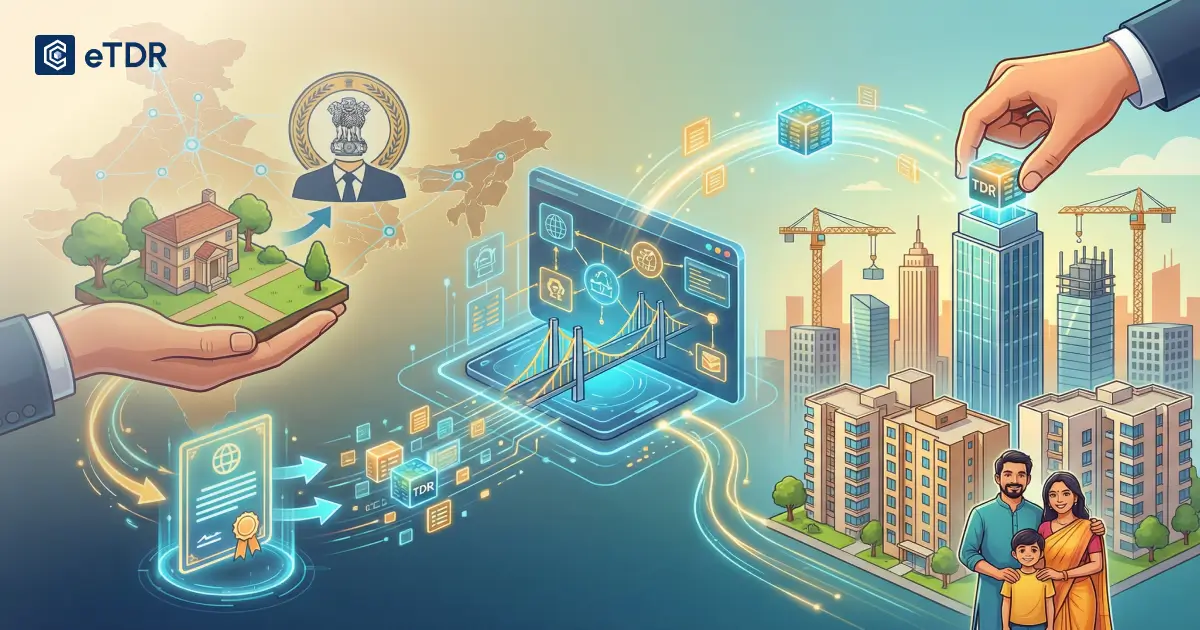
India’s cities are acquiring land at a rate that demands faster, more reliable administration. Roads, drainage corridors, parks, and public housing projects all require private land. Municipal bodies issue Transferable Development Rights certificates to compensate landowners who surrender that land for public use. The policy enabling this process is well-established at both the national and state levels. In most Indian cities, the administration supporting it is still paper-based. That is a governance gap, and it sits directly with municipal corporations and urban development authorities. 

The Policy Is Ready. The Execution Is Not. 

India’s national TDR policy framework calls explicitly for a robust mechanism to prevent fraudulent transactions and enhance the commercial value of TDR certificates. The Ministry of Housing and Urban Affairs included TDR as a primary Value Capture Finance method for delivering infrastructure without cash payouts. 

The framework exists. What most cities are missing is the operational infrastructure to execute it. TDR functions as a proven urban planning tool across dozens of Indian cities. Yet the administration behind it still depends on physical certificates, manual verification, and paper registers. That gap between policy intent and administrative reality is where governments carry the highest cost. 

A digital TDR platform is what closes this gap. 

Paper TDR Puts Municipal Bodies at Legal and Audit Risk 

Physical TDR certificates carry risks that fall directly on the issuing authority. Staffing improvements alone cannot resolve them. These are structural problems of the paper medium. 

  • Forgery and duplication: A paper certificate can be copied and submitted to multiple building applications before any authority detects it. The issuing body carries the legal exposure when this happens. 
  • No defensible audit trail: Courts, the Comptroller and Auditor General, and RTI applicants can request a complete record of TDR issuance, transfer, and utilisation. A physical register does not satisfy this requirement. 
  • Verification delays: Manual cross-checking of paper files takes days or weeks. This slows building approvals and delays infrastructure delivery that TDR was issued to fund. 
  • Record loss: Replacing a damaged or lost TDR certificate requires legal proceedings that consume time from both the landowner and the issuing authority. 

A digital TDR platform addresses each of these exposures at the system level. Effective TDR management at city scale requires digital certificate issuance, immutable audit logs, and instant verification as baseline capabilities. 

Four Departments, Four Versions of the Same Record 

TDR administration spans at least four municipal departments. Each holds a separate fragment of the process: 

  • The Revenue Department processes land ownership verification and surrender documentation 
  • The Town Planning Department issues TDR certificates against development plan reservations 
  • The Building Permissions Department checks TDR eligibility when a developer applies a certificate at the plan approval stage 
  • RERA portals require compliance verification for real estate projects that use TDR 

Each department maintains its own records. A building permissions officer verifying certificate validity has no real-time link to what Town Planning has issued or what the Revenue Department has registered. 

India’s land records digitisation programme has established this principle at the national level: shared, accurate digital records reduce disputes and improve governance across departments. Development rights at the city level require the same logic. A digital TDR platform gives every department access to the same live record, creating one source of truth across the entire municipal system. 

City Planners Cannot Manage What They Cannot See 

Urban development authorities are responsible for density management. TDR directly affects density because it allows developers to build beyond the standard Floor Space Index in designated receiving zones. 

Without a digital TDR platform, planners cannot answer the questions that density management requires in real time: 

  • How many TDR certificates has the city issued this year, and from which sending zones? 
  • How many have been transferred to developers and are in active use? 
  • Which receiving zones are approaching their infrastructure capacity? 

Paper records cannot produce these answers accurately. Smart city planning built on incomplete TDR data produces predictable failures. Some zones absorb more construction than their infrastructure can support. Viable development corridors remain underused because planners have no data to direct growth toward them. 

A digital TDR platform gives commissioners and urban development authorities live dashboards. They can see how much e-TDR has been issued, transferred, utilised, and blocked across every zone at any point in time. Planning decisions become data-driven. 

TDR Is a Public Financial Instrument. It Needs to Be Protected Like One. 

When a municipal corporation issues a TDR certificate instead of cash compensation, it creates a financial instrument backed by public land. That certificate enters the market and unlocks additional construction rights worth significant capital value. 

When certificates are forged, duplicated, or traded through opaque broker networks, the consequences are direct: 

  • Landowners receive below-market rates because pricing is controlled by intermediaries with information advantages 
  • Developers overpay because they cannot verify the available supply in a given zone 
  • Municipal bodies lose the effectiveness of TDR as a land acquisition tool when market confidence erodes 

A transparent TDR market can only exist when the government creates and maintains the infrastructure for it. Digital issuance and instant e-TDR verification give TDR certificates the credibility of a regulated financial instrument. The full e-TDR certificate lifecycle must be managed end to end, from issuance through transfer to final utilisation at the building approval stage, for this credibility to hold. 

India Is Digitising Land Records. Development Rights Are Being Left Behind. 

The Government of India has committed over Rs 875 crore to the Digital India Land Records Modernisation Programme, bringing rural land record digitisation close to full completion across states. The programme covers ownership records, cadastral maps, and registration integration. 

TDR certificates fall outside this scope. A development right separates the right to build from the land itself and allows that right to be transferred and traded independently. This category of urban land governance sits beyond what national land record programmes currently address. 

For municipal corporations and urban development authorities, this gap is specific and addressable. A digital TDR platform extends India’s broader digital land governance commitment to urban development rights. Cities already committed to improving urban development outcomes through digital administration are well-positioned to implement e-TDR as the next governance layer. 

EveryCRED eTDR: Built for Municipal Governance 

Municipal corporations and urban development authorities need a platform built specifically for this governance environment. We built EveryCRED eTDR to address the challenges described in this article. 

Platform capabilities: 

  • eTDR Issuance Platform: Digital certificate creation with configurable multi-level approval workflows, e-signatures, and automatic blockchain anchoring at every stage 
  • eTDR Bank: A city-level repository that shows total e-TDR issued, available, transferred, utilised, and blocked, updated in real time 
  • eTDR Marketplace: A government-regulated platform for direct, compliant transactions between landowners and developers, with transparent pricing visible to all authorised participants 
  • City Map View: GIS-integrated zone and parcel map showing where TDR has been issued and utilised across the city 
  • Instant Verification: Certificate authenticity confirmed via QR code or unique ID with no office visit required 

We integrate with DigiLocker, RERA portals, GIS systems, and existing municipal ERP software, so implementation works alongside current systems. Municipal corporations evaluating a shift from paper to a digital TDR platform can request a working demo of EveryCRED eTDR. 

Conclusion 

TDR is one of the most practical instruments available to Indian governments for land acquisition without cash payouts. The policy foundation across national guidelines and state regulations is solid. What determines whether TDR delivers at scale is the administrative system managing it. A digital TDR platform gives municipal corporations the governance infrastructure they need: tamper-proof e-TDR certificates, live planning data, inter-departmental coordination, and a defensible audit trail. Cities that build this infrastructure will issue TDR faster, reduce disputes, and make more reliable planning decisions at every stage of urban development. 

How TDR Works in Real Estate Projects and Why India Is Moving to Digital Management

India’s cities need land for roads, parks, schools, and public utilities. Acquiring that land is expensive and slow. Transferable Development Rights (TDR) give civic bodies a tool to obtain land without large cash payouts, while giving developers a legal path to build beyond standard floor space limits. 

Let’s show you how TDR works, the types in use across India, who gains from the process, why traditional systems have created persistent problems, and how e-TDR platforms are replacing them. 

What Is TDR and What Problem Does It Solve 

TDR is a legal mechanism that separates development rights from land ownership. 

When a civic body acquires private land for a public project, it compensates the landowner with a Development Rights Certificate (DRC). This DRC represents a certain amount of FSI (Floor Space Index) credit. The landowner can use this credit on another plot or sell it to a developer who needs additional building rights. 

The Ministry of Housing and Urban Affairs includes TDR as one of ten instruments in its Value Capture Finance framework, which guides how Urban Local Bodies fund infrastructure without direct government expenditure. 

TDR serves three direct purposes: 

  • Compensates landowners without requiring large government cash payments 
  • Allows civic bodies to acquire land for infrastructure with a lower financial burden 
  • Redirects development density to zones that have the infrastructure to support it 

How TDR Works: From Land Surrender to Construction Approval 

Understanding how TDR works means following the full transaction from land identification to building approval. 

Step 1: Zone Designation 

City master plans define two types of zones: 

  • Sending zones, where development is restricted (heritage sites, green reserves, road widening corridors) 
  • Receiving zones, where higher-density construction is permitted 

Step 2: Land Surrender 

A landowner in a sending zone surrenders the land to the civic authority for public use. The land must be free of encumbrances. 

Step 3: DRC Issuance 

The civic body issues a Development Rights Certificate specifying the FSI credit. This is calculated based on the surrendered plot area and the FSI applicable to that zone under the local Development Control Regulations (DCR). 

Step 4: TDR Sale 

The DRC is a negotiable instrument. The landowner can sell it to a developer. Pricing is market-driven, based on supply, demand, and location. 

Step 5: Developer Utilisation 

The developer registers the purchased TDR against a receiving plot. This allows construction beyond the base FSI limit set by local DCR rules. 

That is how TDR works at the process level. The mechanism is consistent across cities, though multipliers and zone designations vary by state. 

India’s Four Main Types of TDR, Explained 

TDR is not a single category. It applies differently based on the land type involved: 

  1. Road TDR: Issued when a landowner surrenders land for road widening. Common in cities undertaking large infrastructure corridor projects. 
  1. Slum TDR: Issued for land involved in Slum Rehabilitation Authority (SRA) approved projects. This is the most widely used type in urban construction across India. 
  1. Heritage TDR: Issued to owners of heritage structures who maintain and preserve the property in exchange for development rights. This protects historically significant buildings from demolition pressure. 
  1. Reserved Plots TDR: Issued when land earmarked for parks, playgrounds, or schools is surrendered to the civic body. 

State-level DCR frameworks govern which types apply in each city and what multipliers are used to calculate FSI credit. 

Who TDR Benefits and by How Much 

TDR creates measurable value for each stakeholder involved: 

Landowners 

They receive fair compensation through a DRC rather than a below-market cash payment from the government. They retain land title and can sell the rights for market-driven income. 

Real Estate Developers  

They gain additional FSI beyond the base limit. This allows larger, more financially viable projects on the same plot. Developers in Mumbai, Pune, and Hyderabad regularly integrate slum TDR into project planning to unlock additional buildable area without purchasing new land. 

Municipal Corporations and Urban Development Authorities 

TDR allows land acquisition for public infrastructure with a lower upfront cost. Processing fees on TDR transfers also contribute to municipal revenue. 

Smart City Mission Teams 

TDR directs urban density toward zones with existing infrastructure. This reduces pressure on areas that cannot yet support rapid population growth, which supports more balanced development planning. 

How Broker Networks Have Kept TDR Markets Closed and Opaque 

The traditional paper-based TDR system has clear and documented problems: 

  • Transfers happen informally through direct contacts or brokers, with no price transparency 
  • Broker networks control access to TDR inventory, which inflates transaction costs 
  • Paper certificates carry risks of duplication, loss, and fraudulent transfer 
  • Smaller stakeholders, including flat owners and housing societies, cannot access TDR without paying intermediary fees 
  • There is no central record of how many DRCs are in circulation at any given time 
  • Manual processing extends approval timelines, delaying project delivery for developers 

These barriers have reduced TDR adoption in cities where it could otherwise be used at a larger scale. 

Why Indian Cities Are Now Racing to Build Digital TDR Infrastructure 

Governance bodies are responding. In April 2025, Maharashtra inaugurated its first online TDR exchange, developed by the Brihanmumbai Municipal Corporation. The platform dematerialises all DRCs, routes financial transactions through the State Bank of India as the nodal bank, and gives individual flat owners and housing societies direct access to TDR without broker dependency. 

Hyderabad’s GHMC has offered double TDR for specific infrastructure-related acquisitions. GIS-mapped TDR data is already publicly available through MCGM’s portal in Mumbai. These are not isolated pilots. They reflect a national shift in how urban authorities think about e-TDR adoption as a governance standard. 

For developers, this means faster access to verified TDR inventory. For civic authorities, it means a visible and auditable record of all transactions. For urban planning teams, it means better data on density distribution across the city. 

The Verification Gap That a Digital Marketplace Alone Does Not Close 

A digital marketplace makes TDR more accessible. It does not, by itself, make TDR certificates tamper-proof or instantly verifiable. 

Paper DRCs can be replicated or fraudulently transferred. A standard listing system still relies on manual verification of certificate authenticity. This slows approval cycles and introduces risk for developers, lenders, and civic authorities who rely on TDR as a project input. 

The solution is to convert DRCs into verifiable credentials backed by decentralized identity standards. Each DRC becomes a cryptographically signed digital document tied to the issuing civic authority’s verified identity. Any stakeholder, including developers, lenders, or approving authorities, can confirm certificate authenticity in seconds without contacting the issuing office. 

This is how e-TDR works when built on a verifiable credential infrastructure. The certificate carries its own proof of validity. This is also how digital credentials are transforming public governance in India more broadly, and TDR management is a direct application of that shift. 

EveryCRED’s e-TDR Platform: Verified at Every Stage 

EveryCRED’s e-TDR platform applies Decentralized Identifiers (DID) and verifiable credentials to the complete TDR lifecycle. The platform is built for municipal corporations, urban development authorities, and real estate developers who manage TDR at scale. 

Key capabilities include: 

  • Cryptographically signed digital issuance of DRCs by civic authorities 
  • Instant verification of certificate authenticity for developers, lenders, and approving bodies 
  • Immutable audit logs for every transfer event 
  • Scalable deployment that works across cities with different DCR frameworks 

This removes manual cross-checking at every stage, reduces approval cycles, and creates a provable chain of custody from DRC issuance to utilisation. If your organisation is managing TDR through paper records or a basic digital listing, talk to the EveryCRED team to see how the platform works in your specific city context. 

Conclusion 

TDR is a tested urban planning instrument that benefits landowners, developers, and civic bodies when it functions correctly. Understanding how TDR works at the process level helps every stakeholder use it efficiently and compliantly. The shift from paper management to e-TDR systems is already happening across India’s major cities. The next step is ensuring that digital TDR certificates are verifiable and tamper-proof from the point of issuance, not just accessible on a marketplace. That is the difference between digitising a process and genuinely improving it.