TDR Investment in Real Estate: What India’s Developers and Cities Are Getting Right Now

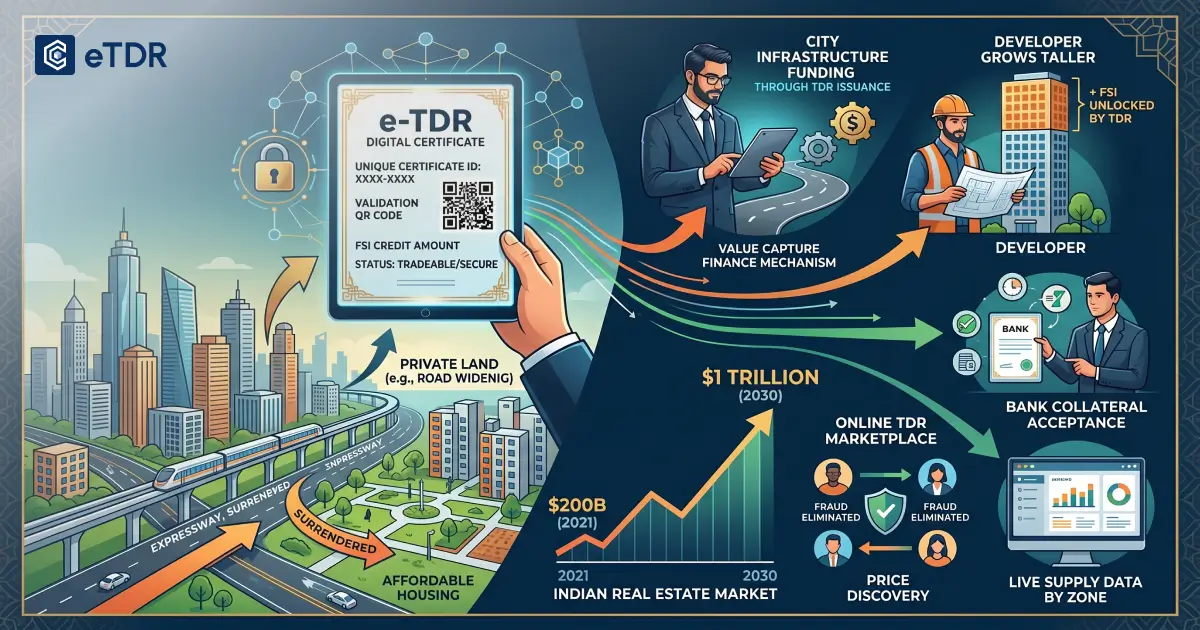
India’s cities are acquiring private land at a pace that the old paper-based system cannot sustain. Road widening, public parks, drainage corridors, and affordable housing projects all require land. Municipal corporations issue Transferable Development Rights certificates to compensate landowners instead of making cash payments. Those certificates carry real monetary value. They can unlock additional floor space on a receiving plot or be sold to a real estate developer.

TDR investment has moved well beyond its origins as a planning workaround. In cities like Mumbai, Hyderabad, Pune, and Ahmedabad, it operates as a structured market instrument. Developers buy TDR to expand project scale. Landowners hold Development Rights Certificates (DRCs) as income-generating assets. Cities use TDR issuance to finance infrastructure without depleting their budgets.

Here, we have covered the investment case for TDR, the factors that determine its value, the risks that have held the market back, and how e-TDR infrastructure is changing those conditions.

Why TDR Has Earned Its Place as a Serious Investment Instrument

TDR is not speculative. It is a government-issued certificate backed by surrendered land with a defined FSI credit attached to it. The Ministry of Housing and Urban Affairs placed TDR inside its Value Capture Finance Policy Framework in 2017, recognising it as one of ten approved mechanisms for urban bodies to manage infrastructure financing. That government endorsement gives TDR investment a legitimacy that most alternative real estate instruments do not carry.

The World Bank has documented TDR’s role as a value capture tool suited specifically to fast-urbanising economies where municipal budgets are under pressure. The instrument allows cities to acquire land without cash outflow while simultaneously creating a tradeable asset in the private market.

India’s real estate sector is projected to reach $1 trillion by 2030, up from $200 billion in 2021. TDR is not a parallel mechanism to that growth. It is embedded inside it — it funds the infrastructure that makes urban density possible.

What Actually Determines the Value of a TDR Certificate

TDR pricing is not arbitrary. It follows specific, measurable factors. Any serious TDR investment decision must account for these.

Receiving zone location

A TDR certificate can only be used in designated receiving areas. Zones near metro corridors, IT clusters, and business districts attract higher developer demand. Higher demand pushes TDR prices up in those areas.

FSI scarcity in the receiving zone

Where base FSI limits are tightly controlled, developers have a stronger need for TDR to unlock additional buildable area. That regulatory scarcity is a direct support for price.

Infrastructure investment nearby

New expressways, metro extensions, and greenfield airports in peripheral zones increase developer activity in those areas. TDR applicable to those receiving zones appreciates alongside the infrastructure investment.

Active supply in the market

Cities that track total TDR issued, utilised, and available give investors a clear picture of supply. Cities that do not track this data leave investors making decisions on incomplete information.

Urban redevelopment pipelines

Colliers India’s 2026 real estate outlook identifies TDR frameworks as a key driver of urban redevelopment in Mumbai, Delhi NCR, Bengaluru, and Chennai. As older buildings in dense zones are redeveloped, TDR demand in eligible receiving zones increases directly.

The Risks That Have Kept TDR Investment from Reaching Its Potential

TDR investment carries documented risks. Understanding them is essential before committing capital.

The NITI Aayog TDR Guidelines explicitly acknowledge two core investor concerns: monetary value uncertainty tied to overall property market conditions, and liquidity risk when a DRC holder needs to exit but cannot locate a buyer quickly.

Physical DRCs add a third problem. Forged certificates have been submitted in multiple building approvals in Indian cities, creating legal exposure for buyers who paid full market price for fraudulent documents.

Additional risks include:

  • Zone mismatch: A receiving plot outside the eligible zone makes the TDR certificate unusable there. The purchase price is effectively lost.
  • Broker-controlled pricing: Without a transparent market, sellers receive below-market rates and buyers overpay. Neither party has access to historical transaction data.
  • No central supply registry: In most cities, there is no way to confirm in real time how many certificates are active, transferred, or already utilised.
  • Manual verification delays: Cross-checking paper DRCs at the building approval stage adds weeks to project timelines and creates financial exposure.

Proper certificate verification is a non-negotiable step in any TDR purchase. Without it, the investment carries legal risk that cannot be quantified after the fact.

How the Shift to e-TDR Changes the Investment Math

Each of the above risks has a direct solution in a digital TDR system. The shift from paper to e-TDR does not just improve administration. It changes the fundamental conditions that determine whether TDR investment is viable.

Fraud is structurally eliminated

A blockchain-anchored e-TDR certificate cannot be duplicated or forged. Its unique identifier is permanently recorded. Any attempt to use a consumed certificate is blocked automatically at the system level.

Price discovery replaces broker dependency

The move toward an online TDR marketplace gives both buyers and sellers access to the same supply data and transaction history. The information advantage that brokers have held is removed.

Banks can assess TDR as collateral

A QR code or unique certificate ID confirms authenticity in seconds. Banks no longer need weeks of manual verification to process TDR-backed applications. This opens TDR investment to leveraged acquisition structures for the first time in most cities.

Landowners can exit without intermediaries

Selling TDR rights through a digital platform means the holder does not need a broker to locate a buyer or complete a transfer. Ownership changes in minutes through the platform.

Developers get live supply data before committing

Smart city TDR systems give developers, planners, and institutional buyers real-time visibility into TDR volumes by zone. Investment decisions are made on verified supply data rather than broker estimates.

Who Should Be Thinking About TDR Investment Right Now

TDR investment works differently depending on the stakeholder. The opportunity is real for each of the following groups, though the logic differs.

Real estate developers

Developers buying TDR to unlock FSI gain buildable area at a cost consistently lower than acquiring equivalent land. In constrained urban zones, that additional area directly affects project margins, unit count, and approval speed. TDR investment at the right stage of a project is a cost management decision as much as a planning one.

Landowners holding DRCs

A verified, digitally issued TDR certificate is a liquid asset. Holding it means holding government-backed FSI credit that appreciates as demand rises in the receiving zone. The exit is straightforward through a digital marketplace, without dependence on a single buyer.

Municipal corporations and urban development authorities

Every TDR transaction represents land acquired, a public project enabled, and a certificate monetised through private capital. Cities that manage TDR well attract higher developer participation, which in turn finances more infrastructure. TDR investment by developers is the mechanism through which city infrastructure gets funded without placing the full burden on the municipal budget.

Banks and financial institutions

A digitally issued e-TDR certificate, backed by blockchain and carrying a verifiable audit trail, addresses the primary lender concern: authenticity. Banks gain the ability to process TDR-backed financing without the delays and uncertainty that paper certificates introduce.

EveryCRED eTDR Is the Best Solution for the TDR Investment Market India Needs

The investment case for TDR is clear. The barrier has always been execution: verifying certificates, tracking ownership, and accessing a transparent market where buyers and sellers can transact with confidence.

We built EveryCRED eTDR to address these problems directly, for municipal corporations, developers, landowners, and financial institutions. The platform issues blockchain-anchored e-TDR certificates with multi-level approval workflows and automatic tamper-proof recording. Every certificate carries a unique ID and QR code for instant verification by any authorised party.

We connect all stakeholders on a single auditable platform: issuers, holders, buyers, and verifiers. The eTDR Bank gives city administrators live data on total TDR issued, available, utilised, and blocked across all zones. The eTDR Marketplace lets verified holders list certificates and developers purchase them with full compliance checks in place.

The platform is aligned with RERA, DigiLocker, GIS systems, and Smart City Mission mandates. It operates on W3C Verifiable Credentials standards, making e-TDR certificates issued by one municipal body verifiable by any other authority.

If your city, development authority, or organisation is ready to make TDR investment credible and traceable, connect with our team to see the platform in action.

Conclusion

TDR has always carried genuine investment value. What has limited its adoption is the absence of reliable infrastructure to issue, verify, and trade certificates at scale. As India’s urban development cycle accelerates and land acquisition pressure grows across every major city, TDR investment is becoming a practical strategy for developers, landowners, and urban authorities. The transition to e-TDR is the critical enabler of that shift — turning a paper-based administrative process into a transparent, bankable, and credible asset class.
Why Governments Need Digital TDR Platforms

India’s cities are acquiring land at a rate that demands faster, more reliable administration. Roads, drainage corridors, parks, and public housing projects all require private land. Municipal bodies issue Transferable Development Rights certificates to compensate landowners who surrender that land for public use. The policy enabling this process is well-established at both the national and state levels. In most Indian cities, the administration supporting it is still paper-based. That is a governance gap, and it sits directly with municipal corporations and urban development authorities. 

The Policy Is Ready. The Execution Is Not. 

India’s national TDR policy framework calls explicitly for a robust mechanism to prevent fraudulent transactions and enhance the commercial value of TDR certificates. The Ministry of Housing and Urban Affairs included TDR as a primary Value Capture Finance method for delivering infrastructure without cash payouts. 

The framework exists. What most cities are missing is the operational infrastructure to execute it. TDR functions as a proven urban planning tool across dozens of Indian cities. Yet the administration behind it still depends on physical certificates, manual verification, and paper registers. That gap between policy intent and administrative reality is where governments carry the highest cost. 

A digital TDR platform is what closes this gap. 

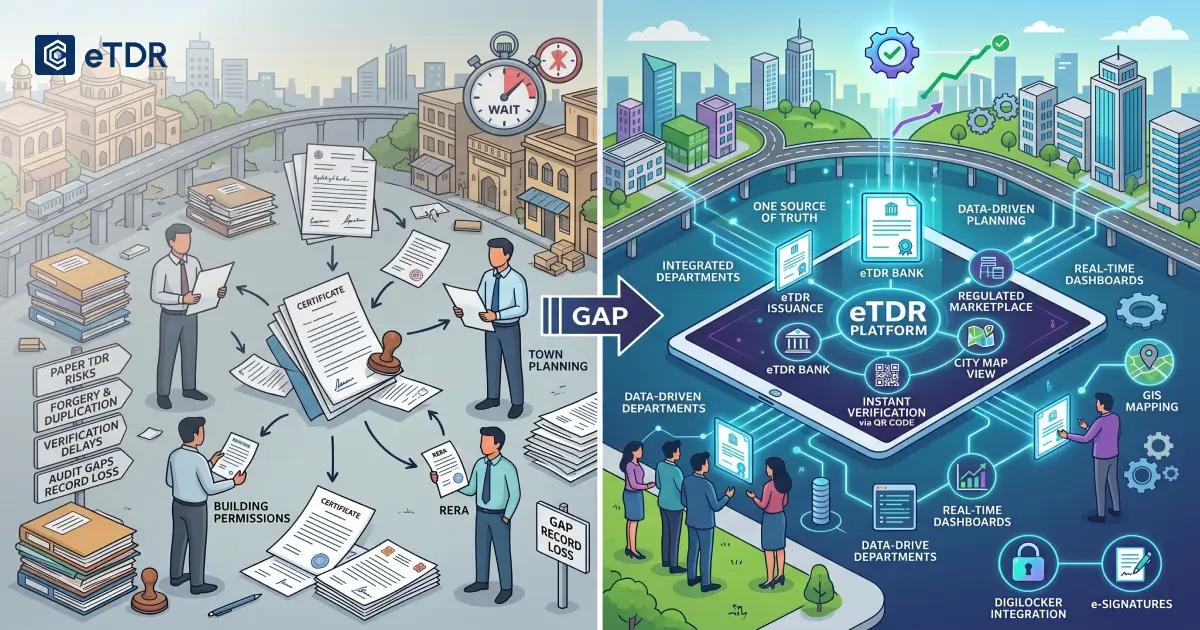
Paper TDR Puts Municipal Bodies at Legal and Audit Risk 

Physical TDR certificates carry risks that fall directly on the issuing authority. Staffing improvements alone cannot resolve them. These are structural problems of the paper medium. 

  • Forgery and duplication: A paper certificate can be copied and submitted to multiple building applications before any authority detects it. The issuing body carries the legal exposure when this happens. 
  • No defensible audit trail: Courts, the Comptroller and Auditor General, and RTI applicants can request a complete record of TDR issuance, transfer, and utilisation. A physical register does not satisfy this requirement. 
  • Verification delays: Manual cross-checking of paper files takes days or weeks. This slows building approvals and delays infrastructure delivery that TDR was issued to fund. 
  • Record loss: Replacing a damaged or lost TDR certificate requires legal proceedings that consume time from both the landowner and the issuing authority. 

A digital TDR platform addresses each of these exposures at the system level. Effective TDR management at city scale requires digital certificate issuance, immutable audit logs, and instant verification as baseline capabilities. 

Four Departments, Four Versions of the Same Record 

TDR administration spans at least four municipal departments. Each holds a separate fragment of the process: 

  • The Revenue Department processes land ownership verification and surrender documentation 
  • The Town Planning Department issues TDR certificates against development plan reservations 
  • The Building Permissions Department checks TDR eligibility when a developer applies a certificate at the plan approval stage 
  • RERA portals require compliance verification for real estate projects that use TDR 

Each department maintains its own records. A building permissions officer verifying certificate validity has no real-time link to what Town Planning has issued or what the Revenue Department has registered. 

India’s land records digitisation programme has established this principle at the national level: shared, accurate digital records reduce disputes and improve governance across departments. Development rights at the city level require the same logic. A digital TDR platform gives every department access to the same live record, creating one source of truth across the entire municipal system. 

City Planners Cannot Manage What They Cannot See 

Urban development authorities are responsible for density management. TDR directly affects density because it allows developers to build beyond the standard Floor Space Index in designated receiving zones. 

Without a digital TDR platform, planners cannot answer the questions that density management requires in real time: 

  • How many TDR certificates has the city issued this year, and from which sending zones? 
  • How many have been transferred to developers and are in active use? 
  • Which receiving zones are approaching their infrastructure capacity? 

Paper records cannot produce these answers accurately. Smart city planning built on incomplete TDR data produces predictable failures. Some zones absorb more construction than their infrastructure can support. Viable development corridors remain underused because planners have no data to direct growth toward them. 

A digital TDR platform gives commissioners and urban development authorities live dashboards. They can see how much e-TDR has been issued, transferred, utilised, and blocked across every zone at any point in time. Planning decisions become data-driven. 

TDR Is a Public Financial Instrument. It Needs to Be Protected Like One. 

When a municipal corporation issues a TDR certificate instead of cash compensation, it creates a financial instrument backed by public land. That certificate enters the market and unlocks additional construction rights worth significant capital value. 

When certificates are forged, duplicated, or traded through opaque broker networks, the consequences are direct: 

  • Landowners receive below-market rates because pricing is controlled by intermediaries with information advantages 
  • Developers overpay because they cannot verify the available supply in a given zone 
  • Municipal bodies lose the effectiveness of TDR as a land acquisition tool when market confidence erodes 

A transparent TDR market can only exist when the government creates and maintains the infrastructure for it. Digital issuance and instant e-TDR verification give TDR certificates the credibility of a regulated financial instrument. The full e-TDR certificate lifecycle must be managed end to end, from issuance through transfer to final utilisation at the building approval stage, for this credibility to hold. 

India Is Digitising Land Records. Development Rights Are Being Left Behind. 

The Government of India has committed over Rs 875 crore to the Digital India Land Records Modernisation Programme, bringing rural land record digitisation close to full completion across states. The programme covers ownership records, cadastral maps, and registration integration. 

TDR certificates fall outside this scope. A development right separates the right to build from the land itself and allows that right to be transferred and traded independently. This category of urban land governance sits beyond what national land record programmes currently address. 

For municipal corporations and urban development authorities, this gap is specific and addressable. A digital TDR platform extends India’s broader digital land governance commitment to urban development rights. Cities already committed to improving urban development outcomes through digital administration are well-positioned to implement e-TDR as the next governance layer. 

EveryCRED eTDR: Built for Municipal Governance 

Municipal corporations and urban development authorities need a platform built specifically for this governance environment. We built EveryCRED eTDR to address the challenges described in this article. 

Platform capabilities: 

  • eTDR Issuance Platform: Digital certificate creation with configurable multi-level approval workflows, e-signatures, and automatic blockchain anchoring at every stage 
  • eTDR Bank: A city-level repository that shows total e-TDR issued, available, transferred, utilised, and blocked, updated in real time 
  • eTDR Marketplace: A government-regulated platform for direct, compliant transactions between landowners and developers, with transparent pricing visible to all authorised participants 
  • City Map View: GIS-integrated zone and parcel map showing where TDR has been issued and utilised across the city 
  • Instant Verification: Certificate authenticity confirmed via QR code or unique ID with no office visit required 

We integrate with DigiLocker, RERA portals, GIS systems, and existing municipal ERP software, so implementation works alongside current systems. Municipal corporations evaluating a shift from paper to a digital TDR platform can request a working demo of EveryCRED eTDR. 

Conclusion 

TDR is one of the most practical instruments available to Indian governments for land acquisition without cash payouts. The policy foundation across national guidelines and state regulations is solid. What determines whether TDR delivers at scale is the administrative system managing it. A digital TDR platform gives municipal corporations the governance infrastructure they need: tamper-proof e-TDR certificates, live planning data, inter-departmental coordination, and a defensible audit trail. Cities that build this infrastructure will issue TDR faster, reduce disputes, and make more reliable planning decisions at every stage of urban development. 

What Is a TDR Management System and Why Indian Cities Need One Now

India’s cities are growing fast. Roads need widening. Parks need land. Drainage corridors, schools, and public utilities require private land that governments must acquire. Cash compensation slows this process down and drains public budgets. Transferable Development Rights offer a practical alternative. But issuing TDR certificates is only one part of the process. 

The infrastructure that governs every step, from land identification to certificate utilisation, is the TDR management system. This article explains what it is, what it must do, and why paper-based systems have failed the cities that rely on them. 

What a TDR Management System Actually Does 

A TDR management system is the administrative and technical infrastructure that manages the complete lifecycle of a TDR certificate. 

When a municipal authority identifies land for a public project, it issues a Development Rights Certificate (DRC) to the landowner who surrenders the land. That DRC represents FSI credit, which the holder can use on another plot or sell to a developer. Every step in this process, from issuance to transfer to utilisation, requires tracking, verification, and record-keeping. 

A functioning TDR management system handles: 

  • Certificate creation with verified land parcel data 
  • Multi-level approval workflows for authorised officers 
  • Ownership records from the first issuance onwards 
  • Transfer registration between landowners and developers 
  • FSI credit tracking against building approvals 
  • Real-time status visibility for all stakeholders 
  • Verification tools for courts, banks, and planning teams 

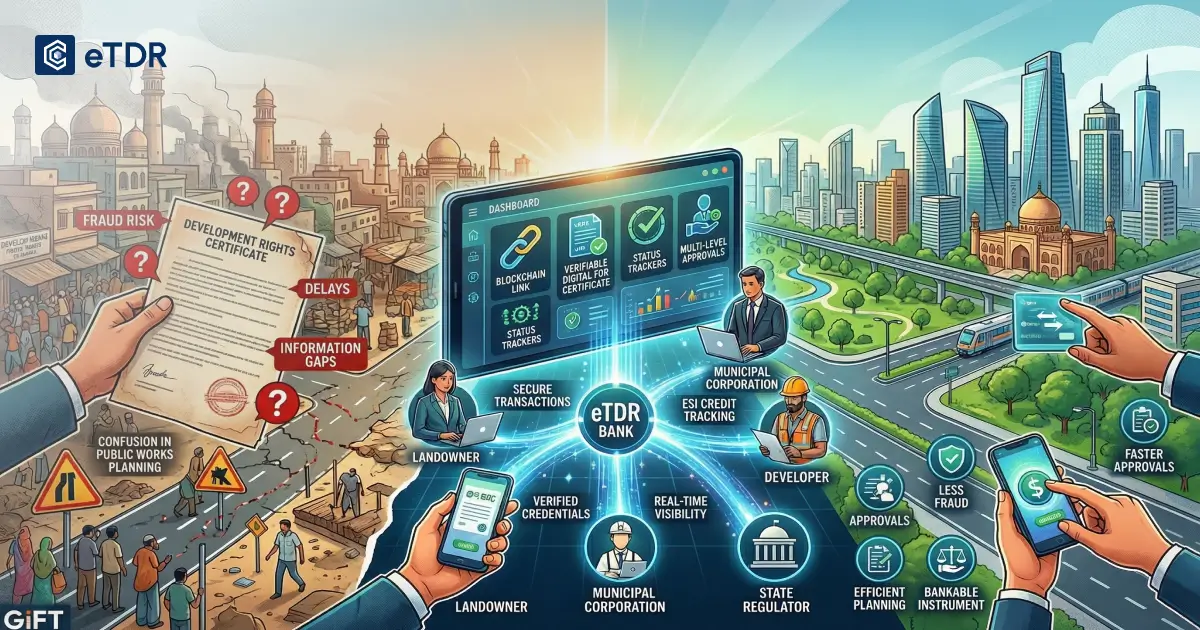
Without this infrastructure, each of these tasks becomes a manual exercise. Manual processes introduce delays, fraud risk, and information gaps that consistently undermine TDR as a policy tool. 

The Four Stakeholders Every TDR System Must Serve 

A TDR management system connects four distinct groups. Each has different needs from the system. 

Municipal Corporations and Urban Development Authorities 

They identify sending zones, verify land ownership, run approval workflows, and issue TDR certificates. They also monitor the total FSI credit in circulation across the city. Understanding how TDR works at each stage is essential for these bodies to manage urban growth effectively. 

Landowners 

They submit applications, receive TDR certificates, and decide whether to use or sell the certificate. They need secure digital storage, clear status visibility, and direct access to buyers without intermediaries. 

Real Estate Developers 

They purchase TDR certificates to unlock additional FSI on their receiving plots. They need verified, instantly transferable certificates and fast clearance at the building permission stage. 

State Governments and Regulators 

They set policy, define sending and receiving zones, and determine FSI multipliers through Development Control Regulations (DCR). They need oversight data on TDR supply and utilisation across urban jurisdictions. 

Each group depends on the others functioning within the same system. A well-built eTDR platform gives each stakeholder role-specific access to the same live data. 

Why Paper-Based TDR Management Has Held Indian Cities Back 

Most cities in India have managed TDR through paper certificates, physical registers, and manual verification. The failures of this approach are documented and structural. 

  • Fraud and forgery: Physical DRCs can be duplicated. Fraudulent certificates have been submitted in multiple building approvals simultaneously in several cities. 
  • No central registry: Without a unified record, no authority can confirm in real time how many certificates are active, transferred, or already utilised. 
  • Pricing controlled by brokers: Landowners receive below-market rates because transaction data is not visible to them. Developers overpay because they have no way to compare prices. 
  • Slow verification: Confirming a paper DRC requires a municipal officer to manually cross-check physical files. This delays building approvals by days or weeks. 
  • Inaccessible for small holders: Individual landowners with small DRC holdings cannot navigate a broker-dependent, information-asymmetric market. 

The NITI Aayog TDR Guidelines (2021) explicitly note that a robust mechanism is required to enhance the commercial value of TDR certificates and prevent fraudulent transactions. Better administration alone cannot fix these problems. Paper is the problem. 

FSI, TDR, and the Data Gap Every City Planner Faces 

FSI is the ratio of built-up area to plot area. TDR allows a developer to exceed the base FSI in a receiving zone by applying a valid DRC. The difference between TDR and FSI is that FSI is fixed to one plot, while TDR is transferable across zones. 

This creates a real-time data challenge for city planners. At any point, a municipal body needs to know: 

  • Total FSI credits issued in each zone 
  • Credits available for purchase in the open market 
  • Credits transferred but not yet applied to a building 
  • Credits fully utilised in approved construction 

Without a live TDR management system tracking this data, planners cannot make informed decisions about development density or infrastructure capacity. Zones receive more construction than they can support. Infrastructure projects stall because TDR supply data does not reach the teams that need it. 

What a Digital TDR Management System Looks Like 

A digital TDR management system replaces paper certificates with blockchain-anchored digital credentials. It automates approvals, records every transaction with timestamps, and makes verification instant. 

The core components:

Issuance Module 

Officers create digital TDR certificates with parcel details, area measurements, and supporting documents. Multi-level e-signatures replace physical sign-offs. Each certificate receives a unique identifier and is permanently recorded on the blockchain. 

Digital TDR Bank 

A central repository that shows the current status of every certificate: pending, issued, transferred, utilised, or blocked. This gives city planners real-time visibility across the city’s full TDR supply. 

Marketplace 

A regulated platform where DRC holders list certificates and developers search by zone, area, and price. Transparent pricing eliminates broker dependency. Both sides of the transaction access the same live market data. 

Instant Verification Portal 

Developers, courts, and banks verify a certificate’s authenticity using a QR code or unique ID. No office visit or manual check is required. 

The World Bank has identified fraud prevention and market transparency as essential conditions for TDR to function as a bankable instrument in Indian cities. A digital e-TDR system is designed precisely to meet both conditions. 

The benefits of this shift are measurable: faster approvals, reduced fraud, lower transaction costs, and better planning data for municipal authorities and urban development teams. 

EveryCRED eTDR Is Built for India’s Municipal Corporations 

EveryCRED eTDR is a complete digital TDR management platform for municipal corporations, urban development authorities, and smart city mission teams. 

Platform capabilities: 

  • Digital certificate issuance with configurable multi-level approval workflows 
  • Blockchain anchoring of every TDR certificate at the point of issuance 
  • A central eTDR Bank with real-time status tracking across the entire city 
  • A regulated marketplace for transparent, compliant TDR transactions 
  • An interactive GIS-based city map with zone classifications and parcel data 
  • Instant verification via QR code or certificate ID for developers, courts, and banks 

The platform is built on W3C Verifiable Credentials standards. It integrates with DigiLocker, RERA portals, GIS systems, and municipal ERP software. Certificates issued by one municipal body are verifiable by any other authority through the same system, enabling cross-city compatibility. 

Municipal corporations and urban development authorities looking to replace manual TDR processes can explore the EveryCRED eTDR platform and request a working demo. 

The Moment Indian Cities Can No Longer Afford to Wait 

India’s urban population is projected to reach approximately 500 million by 2025 and continue climbing through the next decade. Infrastructure demand is accelerating at the same rate. 

A paper-based TDR management system cannot process land acquisition, issue certificates, and clear building approvals at this pace. An e-TDR system built on verifiable digital credentials and a transparent marketplace can. 

The policy framework already exists. NITI Aayog has issued national TDR guidelines. The Ministry of Housing and Urban Affairs includes TDR in its Value Capture Finance framework. TDR as an urban planning instrument has decades of proven use across Mumbai, Hyderabad, Pune, and Ahmedabad. The gap is in implementation. A modern TDR management system closes it. 

Cities that build this infrastructure now will process urban growth with fewer disputes, faster approvals, and better data in every planning decision they make.