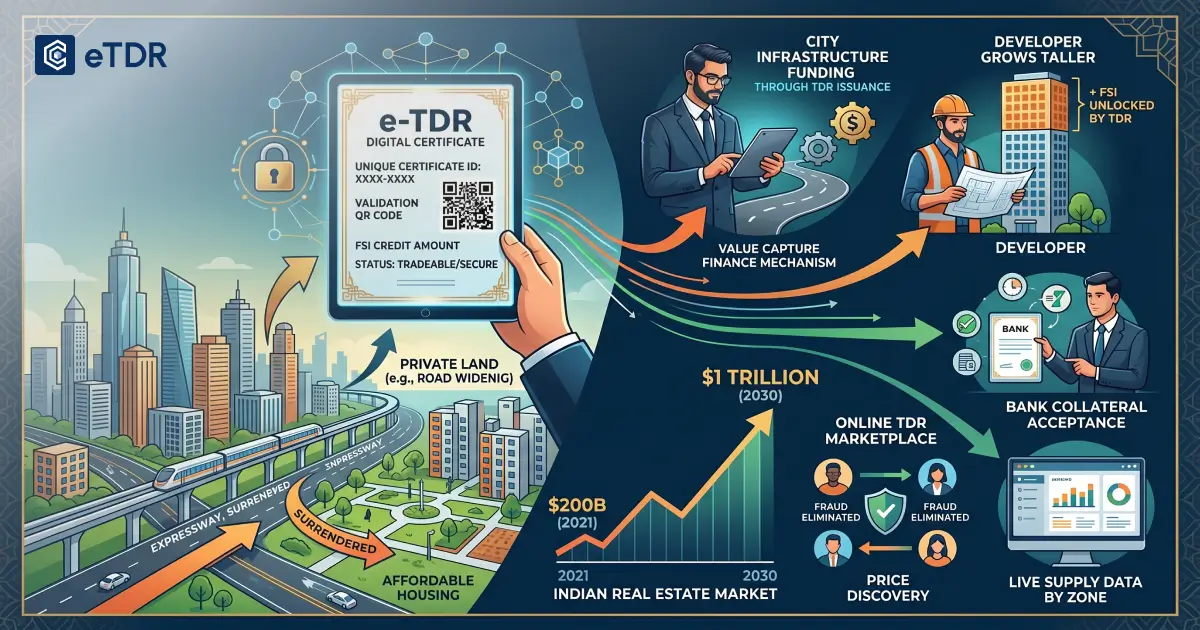
India’s cities are acquiring private land at a pace that the old paper-based system cannot sustain. Road widening, public parks, drainage corridors, and affordable housing projects all require land. Municipal corporations issue Transferable Development Rights certificates to compensate landowners instead of making cash payments. Those certificates carry real monetary value. They can unlock additional floor space on a receiving plot or be sold to a real estate developer.
TDR investment has moved well beyond its origins as a planning workaround. In cities like Mumbai, Hyderabad, Pune, and Ahmedabad, it operates as a structured market instrument. Developers buy TDR to expand project scale. Landowners hold Development Rights Certificates (DRCs) as income-generating assets. Cities use TDR issuance to finance infrastructure without depleting their budgets.
Here, we have covered the investment case for TDR, the factors that determine its value, the risks that have held the market back, and how e-TDR infrastructure is changing those conditions.
Why TDR Has Earned Its Place as a Serious Investment Instrument
TDR is not speculative. It is a government-issued certificate backed by surrendered land with a defined FSI credit attached to it. The Ministry of Housing and Urban Affairs placed TDR inside its Value Capture Finance Policy Framework in 2017, recognising it as one of ten approved mechanisms for urban bodies to manage infrastructure financing. That government endorsement gives TDR investment a legitimacy that most alternative real estate instruments do not carry.
The World Bank has documented TDR’s role as a value capture tool suited specifically to fast-urbanising economies where municipal budgets are under pressure. The instrument allows cities to acquire land without cash outflow while simultaneously creating a tradeable asset in the private market.
India’s real estate sector is projected to reach $1 trillion by 2030, up from $200 billion in 2021. TDR is not a parallel mechanism to that growth. It is embedded inside it — it funds the infrastructure that makes urban density possible.
What Actually Determines the Value of a TDR Certificate
TDR pricing is not arbitrary. It follows specific, measurable factors. Any serious TDR investment decision must account for these.
Receiving zone location
A TDR certificate can only be used in designated receiving areas. Zones near metro corridors, IT clusters, and business districts attract higher developer demand. Higher demand pushes TDR prices up in those areas.
FSI scarcity in the receiving zone
Where base FSI limits are tightly controlled, developers have a stronger need for TDR to unlock additional buildable area. That regulatory scarcity is a direct support for price.
Infrastructure investment nearby
New expressways, metro extensions, and greenfield airports in peripheral zones increase developer activity in those areas. TDR applicable to those receiving zones appreciates alongside the infrastructure investment.
Active supply in the market
Cities that track total TDR issued, utilised, and available give investors a clear picture of supply. Cities that do not track this data leave investors making decisions on incomplete information.
Urban redevelopment pipelines
Colliers India’s 2026 real estate outlook identifies TDR frameworks as a key driver of urban redevelopment in Mumbai, Delhi NCR, Bengaluru, and Chennai. As older buildings in dense zones are redeveloped, TDR demand in eligible receiving zones increases directly.
The Risks That Have Kept TDR Investment from Reaching Its Potential
TDR investment carries documented risks. Understanding them is essential before committing capital.
The NITI Aayog TDR Guidelines explicitly acknowledge two core investor concerns: monetary value uncertainty tied to overall property market conditions, and liquidity risk when a DRC holder needs to exit but cannot locate a buyer quickly.
Physical DRCs add a third problem. Forged certificates have been submitted in multiple building approvals in Indian cities, creating legal exposure for buyers who paid full market price for fraudulent documents.
Additional risks include:
- Zone mismatch: A receiving plot outside the eligible zone makes the TDR certificate unusable there. The purchase price is effectively lost.
- Broker-controlled pricing: Without a transparent market, sellers receive below-market rates and buyers overpay. Neither party has access to historical transaction data.
- No central supply registry: In most cities, there is no way to confirm in real time how many certificates are active, transferred, or already utilised.
- Manual verification delays: Cross-checking paper DRCs at the building approval stage adds weeks to project timelines and creates financial exposure.
Proper certificate verification is a non-negotiable step in any TDR purchase. Without it, the investment carries legal risk that cannot be quantified after the fact.
How the Shift to e-TDR Changes the Investment Math
Each of the above risks has a direct solution in a digital TDR system. The shift from paper to e-TDR does not just improve administration. It changes the fundamental conditions that determine whether TDR investment is viable.
Fraud is structurally eliminated
A blockchain-anchored e-TDR certificate cannot be duplicated or forged. Its unique identifier is permanently recorded. Any attempt to use a consumed certificate is blocked automatically at the system level.
Price discovery replaces broker dependency
The move toward an online TDR marketplace gives both buyers and sellers access to the same supply data and transaction history. The information advantage that brokers have held is removed.
Banks can assess TDR as collateral
A QR code or unique certificate ID confirms authenticity in seconds. Banks no longer need weeks of manual verification to process TDR-backed applications. This opens TDR investment to leveraged acquisition structures for the first time in most cities.
Landowners can exit without intermediaries
Selling TDR rights through a digital platform means the holder does not need a broker to locate a buyer or complete a transfer. Ownership changes in minutes through the platform.
Developers get live supply data before committing
Smart city TDR systems give developers, planners, and institutional buyers real-time visibility into TDR volumes by zone. Investment decisions are made on verified supply data rather than broker estimates.
Who Should Be Thinking About TDR Investment Right Now
TDR investment works differently depending on the stakeholder. The opportunity is real for each of the following groups, though the logic differs.
Real estate developers
Developers buying TDR to unlock FSI gain buildable area at a cost consistently lower than acquiring equivalent land. In constrained urban zones, that additional area directly affects project margins, unit count, and approval speed. TDR investment at the right stage of a project is a cost management decision as much as a planning one.
Landowners holding DRCs
A verified, digitally issued TDR certificate is a liquid asset. Holding it means holding government-backed FSI credit that appreciates as demand rises in the receiving zone. The exit is straightforward through a digital marketplace, without dependence on a single buyer.
Municipal corporations and urban development authorities
Every TDR transaction represents land acquired, a public project enabled, and a certificate monetised through private capital. Cities that manage TDR well attract higher developer participation, which in turn finances more infrastructure. TDR investment by developers is the mechanism through which city infrastructure gets funded without placing the full burden on the municipal budget.
Banks and financial institutions
A digitally issued e-TDR certificate, backed by blockchain and carrying a verifiable audit trail, addresses the primary lender concern: authenticity. Banks gain the ability to process TDR-backed financing without the delays and uncertainty that paper certificates introduce.
EveryCRED eTDR Is the Best Solution for the TDR Investment Market India Needs
The investment case for TDR is clear. The barrier has always been execution: verifying certificates, tracking ownership, and accessing a transparent market where buyers and sellers can transact with confidence.
We built EveryCRED eTDR to address these problems directly, for municipal corporations, developers, landowners, and financial institutions. The platform issues blockchain-anchored e-TDR certificates with multi-level approval workflows and automatic tamper-proof recording. Every certificate carries a unique ID and QR code for instant verification by any authorised party.
We connect all stakeholders on a single auditable platform: issuers, holders, buyers, and verifiers. The eTDR Bank gives city administrators live data on total TDR issued, available, utilised, and blocked across all zones. The eTDR Marketplace lets verified holders list certificates and developers purchase them with full compliance checks in place.
The platform is aligned with RERA, DigiLocker, GIS systems, and Smart City Mission mandates. It operates on W3C Verifiable Credentials standards, making e-TDR certificates issued by one municipal body verifiable by any other authority.
If your city, development authority, or organisation is ready to make TDR investment credible and traceable, connect with our team to see the platform in action.
Conclusion
TDR has always carried genuine investment value. What has limited its adoption is the absence of reliable infrastructure to issue, verify, and trade certificates at scale. As India’s urban development cycle accelerates and land acquisition pressure grows across every major city, TDR investment is becoming a practical strategy for developers, landowners, and urban authorities. The transition to e-TDR is the critical enabler of that shift — turning a paper-based administrative process into a transparent, bankable, and credible asset class.