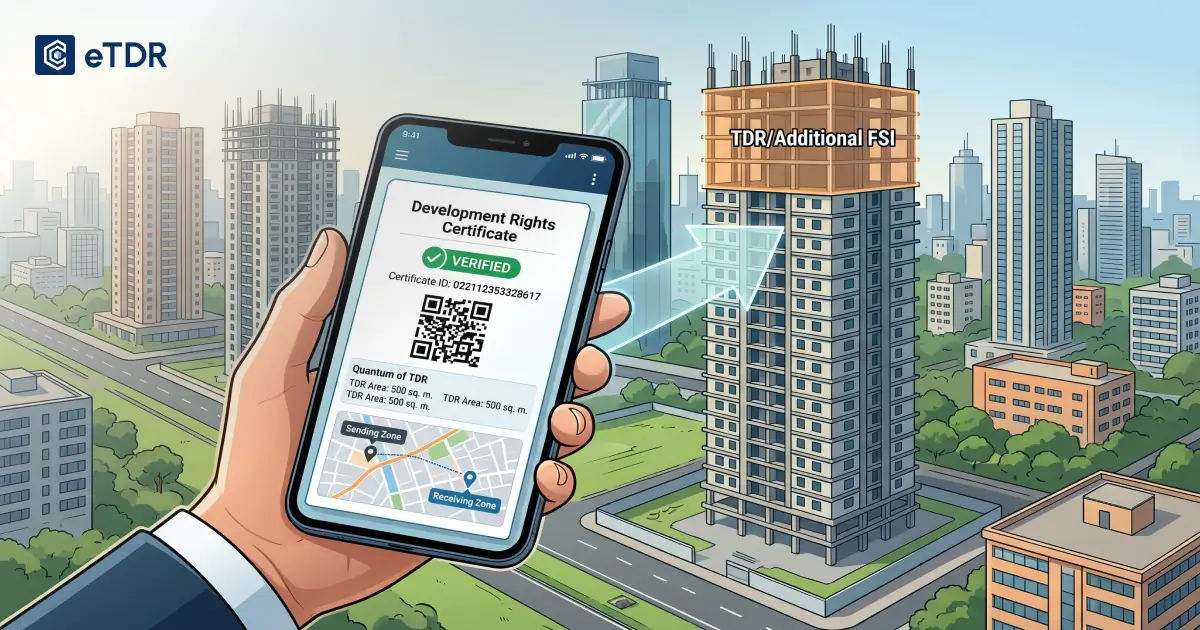
When a developer needs to build beyond the permitted Floor Space Index on a project, one direct option is to buy transferable development rights from a certificate holder.
TDR gives the buyer legal entitlement to additional buildable floor space in a designated receiving zone. The concept is well-established in Indian urban planning. The process, in most Indian cities, is fragmented, opaque, and broker-dependent.
This guide explains how TDR purchases work, who can participate, what to check before committing, and what is changing as cities move toward digital systems.
What TDR Is and Why Developers Buy It
A TDR certificate is issued by a municipal authority to a landowner who surrenders land for public purposes such as road widening, parks, or public housing. The certificate represents a defined quantum of buildable floor space in square metres. The holder can use it on another plot or sell it.
Developers buy transferable development rights for one primary reason: to unlock FSI beyond what base regulations permit on their receiving plots.
Under Mumbai’s DCPR 2034, TDR contributes up to 0.83 FSI on plots abutting roads 27 metres and wider. In high-density cities with constrained base FSI, that additional buildable area directly affects project feasibility and returns.
Who Can Buy Transferable Development Rights in India
TDR functions as a market instrument. It can be purchased by:
- Real estate developers and builders are acquiring additional FSI to receive plots
- Individual landowners applying TDR on their own eligible plots
- Third parties purchasing DRCs as an investment asset and reselling to developers
The relationship between TDR and FSI matters here. FSI is fixed to one specific plot. TDR travels between plots in approved zones. A buyer must confirm that their receiving plot falls in a zone designated to accept TDR under the applicable Development Control Regulations before proceeding.
How the TDR Buying Process Works, Step by Step
The buying sequence applies across most Indian cities with state-level variations in procedure and documentation.
Identify the TDR Requirement
The developer calculates the additional FSI needed and determines the exact quantum of TDR required for the project.
Source a Valid DRC
The buyer identifies a certificate holder willing to sell. In Hyderabad, this happens through the GHMC TDR Bank portal. In Mumbai and cities without a centralised exchange, buyers typically rely on brokers or private negotiations.
Verify the Certificate
Before agreeing to any price, the buyer must confirm:
- The DRC was issued by a competent municipal authority
- The certificate carries a sufficient remaining balance
- The sending zone qualifies and the DRC is eligible for use in the proposed receiving zone
Agree on Price and Execute the Transfer
TDR pricing follows open market principles driven by supply and demand. The transfer is formalised through a registered deed. Stamp duty and registration fees apply per state regulations.
Submit for Building Approval
The purchased DRC is submitted with the building permission application. How TDR is applied in real estate projects at each of these stages directly affects project timelines and approval workflows.
City-by-City: How TDR Purchases Differ Across India
Rules and procedures vary significantly between cities.
Mumbai
TDR is governed under the Maharashtra Regional and Town Planning Act, 1966, and DCPR 2034. Buyers source DRCs through private negotiations. There is no centralised public marketplace. Under RERA, promoters must fully disclose DRC utilisation in project registration documents before any marketing begins.
Hyderabad
The GHMC launched India’s first government TDR Bank portal in February 2020. Buyers access the platform, identify available certificates, and approach sellers online. GHMC has made it mandatory for all manual certificate holders to convert DRCs into digital form before transacting. GHMC has issued over 1,000 TDR certificates valued at approximately Rs 3,500 crore to date.
Other Cities
Ahmedabad, Pune, and Bengaluru operate under state-specific frameworks. The NITI Aayog TDR Guidelines (2021) provide a national template that states and urban local bodies can adapt. These guidelines explicitly recommend that ULBs establish online TDR banks to improve pricing transparency and reduce broker dependency.
Five Things to Verify Before You Buy a TDR Certificate
Buying TDR without proper due diligence can stall a project and create legal exposure.
- Certificate authenticity: Confirm the DRC was issued by the competent municipal authority. Physical certificates have been forged in several Indian cities.
- Utilisation balance: A partially used certificate may carry a remaining area below what the project requires. Verify the exact available figure.
- Zone eligibility: The receiving plot must fall in a designated receiving zone. Not all areas qualify under local DCR rules.
- RERA compliance: If used in a registered project, the DRC must be disclosed at registration. Apartment buyers in that project have the right to see this information.
- Registered transfer: Every TDR transfer must go through a registered deed. An unregistered agreement has no legal standing.
The Hidden Cost of Buying TDR Without Verified Data
Most TDR transactions in cities without a regulated marketplace go through brokers. Two consequences follow for buyers.
Pricing is opaque. The same DRC can trade at different values because buyers have no access to supply data or historical price records. Developers consistently overpay in markets where brokers control information.
Fraud risk is measurable. Physical DRCs can be forged. A fraudulent certificate can be submitted to multiple building approval processes before the issue is identified. By then, funds have transferred and the project timeline has been disrupted.
The advantages of a verified digital TDR system address both of these problems at the source.
Why India’s TDR Market Is Shifting to Digital Systems
India’s policy framework has supported this shift for several years.
The Ministry of Housing and Urban Affairs included TDR in its Value Capture Finance Policy Framework in 2017. NITI Aayog followed with national guidelines in 2021, calling explicitly for digital decision-support systems and online TDR banks to reduce transaction costs and eliminate broker dependency.
The World Bank has noted that TDR needs both fraud prevention mechanisms and pricing transparency to function as a bankable instrument in Indian cities.
GHMC’s TDR Bank was cited by NITI Aayog as a national best practice. Several states are now evaluating similar digital systems for their municipal bodies.
e-TDR, or Electronic Transferable Development Rights, converts paper DRCs into blockchain-anchored digital credentials. Each certificate carries a cryptographic identifier and cannot be duplicated or altered after issuance. Verification happens instantly through a QR code or unique certificate ID. What eTDR means in practice shows exactly where the process improves for buyers, sellers, and approving authorities.
What Buying TDR Looks Like on a Digital Platform
On a system that issues e-TDR, the purchasing process is structured and auditable from end to end.
- Municipal bodies issue digital DRCs through a multi-level approval workflow with e-signatures at each stage
- Each e-TDR certificate is recorded on the blockchain at the point of issuance
- Buyers access a regulated marketplace with real-time pricing and certificate availability data
- Verification takes seconds using a QR code or unique certificate ID
- Every transfer is recorded digitally with a complete ownership trail from first issuance
- Building approval teams confirm DRC validity in real time without manual cross-checks
The full e-TDR certificate lifecycle, from land identification to utilisation, is traceable and tamper-proof at every step.
EveryCRED eTDR Is Built for the Authorities That Issue TDR
EveryCRED eTDR is a digital TDR management platform built for Municipal Corporations, Urban Development Authorities, and Smart City Mission teams. It can be used to manage the complete TDR certificate lifecycle on a single secure platform.
Our Platform’s capabilities:
- Digital DRC issuance with configurable multi-level approvals and automatic blockchain anchoring at issuance
- A central eTDR Bank with real-time tracking of all certificate statuses across the entire city
- A regulated marketplace where DRC holders list certificates and developers purchase them with built-in compliance checks
- Instant verification via QR code or certificate ID for developers, banks, and courts
- GIS-based city map showing all TDR-linked parcels with zone classification and area data
For developers who regularly buy transferable development rights, the platform removes the three main barriers in the current process: slow manual verification, opaque market pricing, and fraud exposure from unverifiable physical certificates. When a municipal authority operates on EveryCRED eTDR, every DRC purchased carries an immutable digital record that can be confirmed independently at any stage of the project.
Connect with us to see a demo.
Conclusion
The process to buy transferable development rights in India follows a consistent sequence across cities: identify the requirement, source a valid DRC, verify its status, execute a registered transfer, and submit for building approval.
The main variable between cities is transparency. Cities with digital e-TDR infrastructure give buyers access to verified certificates, visible pricing, and instant confirmation. Cities still dependent on paper processes rely on intermediaries and manual checks.
India’s policy direction on this is established. As more municipal bodies adopt e-TDR systems, the process of purchasing transferable development rights will become faster, more transparent, and more reliable for every party involved.
Leave a Reply