India issues TDR certificates to landowners who surrender private land for roads, parks, and public infrastructure. The NITI Aayog guidelines on TDR recognise it as a primary instrument under India’s Value Capture Finance framework. The policy has strong foundations. The administration supporting it does not.
Most Indian cities still manage TDR through physical certificates, manual registers, and in-person file checks. Every stage in that process creates a gap in the record. Municipal officers, developers, landowners, and regulators each hold a fragment of the information. A digital TDR system replaces those fragments with one shared, live record that every authorised party can access at any point.
Why India’s TDR Process Fails on Transparency Before a Single Certificate Gets Forged
The information gap in TDR is structural. It comes from the paper medium itself, not from individual administrative failures.
- The town planning department issues a TDR certificate. The revenue department holds the ownership record. The building permissions department reviews it at the point of use. None of these departments share a live data connection.
- Transfers happen through broker networks. No published transaction price data exists anywhere in the system.
- Verification requires office visits. A bank, court, or planning authority cannot confirm a certificate’s current status without a physical file check.
- City planners have no real-time view of total TDR in circulation or which receiving zones are approaching FSI limits.
Sound TDR management at the city scale requires a shared, live record system. Paper registers do not provide this.
The Six Points in the TDR Lifecycle Where Information Disappears
A TDR certificate moves through six stages: land identification, application, verification, issuance, transfer, and utilisation. In a paper system, information gaps enter at each one.
- Issuance: No shared digital record exists between departments. Each holds its own version of the same event.
- Transfer: Certificates move through intermediaries. The issuing authority is often unaware of subsequent transfers.
- Pricing: No public transaction data exists. Buyers and sellers work with privately shared information.
- Utilisation: When TDR is used to unlock additional FSI at the building approval stage, no automatic link exists back to the issuing authority’s records.
- Verification: Courts, banks, and planning bodies cannot confirm a certificate’s status without manual file retrieval. Instant digital verification of TDR certificates is only possible when a digital record exists in the first place.
- Audit: RTI applicants and CAG auditors requesting a full account of issuance, transfer, and utilisation cannot get one from a manual register.
What a Digital TDR System Puts Back Into the Record
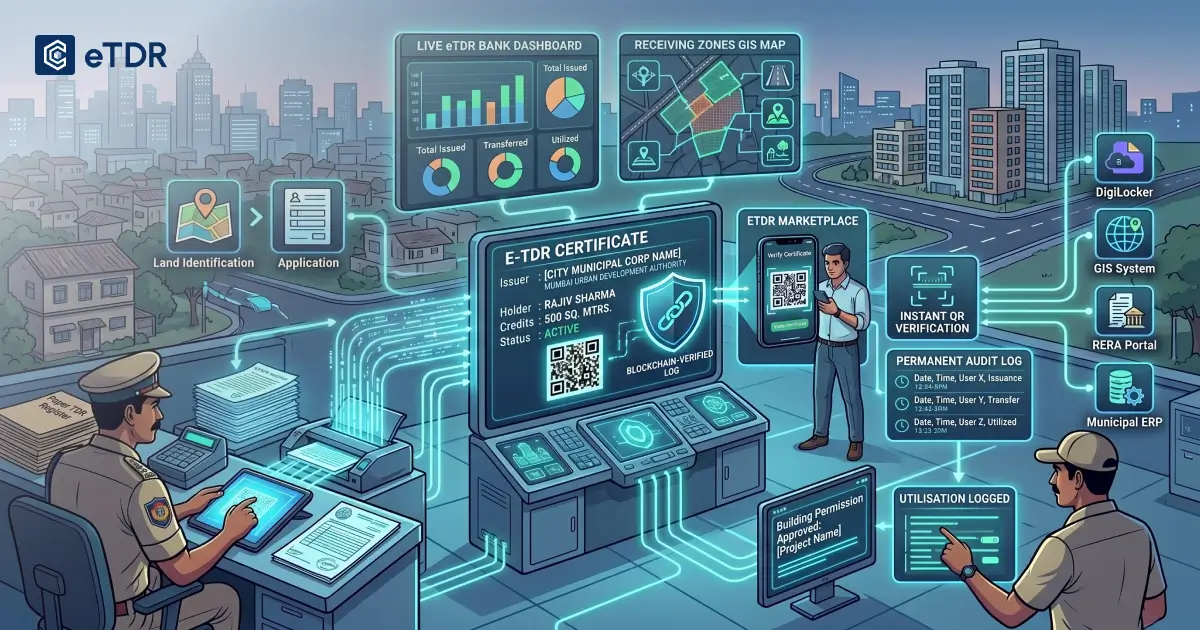
An e-TDR platform replaces the fragmented paper trail with a single authoritative record. The Development Rights Certificate management process shifts from a multi-department paper exercise into a single digital workflow.
Here is what a digital TDR system changes at each stage:
- Issuance: Each certificate is issued as a blockchain-anchored digital credential. The record cannot be altered after issuance.
- Transfer: Every transfer is logged with a timestamp, actor identity, and reference to the original certificate. Ownership history is complete and permanent.
- Pricing: Transaction data on a regulated platform creates pricing benchmarks visible to all market participants.
- Utilisation: Building permits and TDR records exist within the same system. Every utilisation connects back to the issuing authority automatically.
- Verification: Any authorised party can verify a certificate instantly using a QR code or unique certificate ID. No office visit is required.
- Audit: Every officer action, every approval, and every transfer is logged on the blockchain. The record is immutable and immediately available for compliance review.
The full e-TDR lifecycle becomes traceable from land identification to final utilisation in a single system.
What Commissioners and Urban Planners Can Finally See in Real Time
In a paper TDR system, a city commissioner asking “how much TDR is currently in circulation?” cannot get an accurate answer without days of manual reconciliation across multiple departments. A digital TDR system produces this data immediately.
What municipal corporations and urban development authorities gain:
- A live dashboard showing total TDR issued, transferred, in active use, and expired across the entire city.
- Zone-level data showing which receiving areas are absorbing high TDR volume against infrastructure capacity.
- A complete, timestamped audit log for every certificate, every officer action, and every approval at each workflow stage.
- RTI and CAG-ready records that require no manual preparation before submission.
- Multi-level approval visibility from junior engineer through to commissioner, with e-signatures at every step.
For Smart City Mission teams, this smart city alignment between TDR administration and digital governance standards is directly relevant. The National Urban Digital Mission requires Urban Local Bodies to meet open data and interoperability standards. A digital TDR system produces structured, timestamped data that satisfies these requirements from within the normal workflow.
Why Real Estate Developers Are Paying More Than They Should for TDR
The World Bank has identified transparent, liquid TDR markets as essential for the instrument to function as effective urban infrastructure finance. That transparency does not currently exist when transactions are brokered privately and price data remains undisclosed.
Developers operating in opaque TDR markets face three direct costs:
- Information asymmetry: Sellers and buyers do not have equal access to pricing data. Intermediaries capture the gap.
- Verification risk: A developer cannot confirm a certificate’s authenticity before purchase without visiting a municipal office, which adds time and cost to every transaction.
- Approval delays: Manual TDR verification at the building permission stage delays project timelines.
A digital TDR system creates a structured market with visibility for all participants. An online TDR marketplace lists available e-TDR certificates with verified details, published transaction records, and direct transfer on a regulated platform. Certificate availability, pricing, and transfer happen with a complete record of every transaction. Developers reduce dependence on intermediaries and submit e-TDR credentials directly at the building permission stage.
How e-TDR Makes Regulatory Compliance a Built-In Process
In a paper TDR system, regulatory compliance requires collecting records from multiple departments and reconciling them manually. A digital TDR system produces compliance as a standard output of the issuance and transfer workflow.
- RERA filings that require TDR documentation are supported by verified digital credentials that match the project record directly.
- Court proceedings involving disputed certificates have access to an immutable blockchain record with complete provenance history.
- The approval chain from initial application to final issuance is logged at every stage. No reconstruction of records is needed for a legal dispute or regulatory inquiry.
- Inter-city and inter-state verification becomes possible because e-TDR certificates issued on standardised platforms can be verified by any authorised authority.
This is the practical governance outcome of a complete digital TDR system: every action that matters is recorded, verifiable, and permanently available to the parties who need it.
EveryCRED eTDR is for the Accountability Standard Indian Cities Need
Municipal corporations and urban development authorities managing TDR through paper records carry structural transparency gaps that staffing and process improvements cannot resolve. We built the EveryCRED eTDR platform to close these gaps at the system level.
The platform issues tamper-proof TDR certificates as blockchain-anchored verifiable credentials, tracks every transfer with a permanent audit trail, and gives commissioners and town planners a live eTDR Bank dashboard across all city zones. Multi-level approval workflows, e-signatures at every stage, QR-based instant verification, and a regulated eTDR marketplace are all part of a single government-grade system. Alignment with DigiLocker, RERA portals, GIS systems, and municipal ERP software means EveryCRED eTDR works within the infrastructure cities already use.
If your city is ready to move TDR administration from paper registers to a fully auditable digital record, speak with our team to understand what implementation looks like for your jurisdiction.
Conclusion
Transparency in TDR is what makes the instrument function as intended. When issuance, transfer, pricing, and utilisation are visible to the right parties at the right time, TDR works as a reliable land acquisition tool that both governments and developers can trust. A digital TDR system is the infrastructure that makes this possible. Cities that adopt it gain not just efficiency but the kind of documented accountability that paper records cannot provide.
Leave a Reply