How a Digital TDR System Fixes the Transparency Gap in India’s Urban Land Process

India issues TDR certificates to landowners who surrender private land for roads, parks, and public infrastructure. The NITI Aayog guidelines on TDR recognise it as a primary instrument under India’s Value Capture Finance framework. The policy has strong foundations. The administration supporting it does not.

Most Indian cities still manage TDR through physical certificates, manual registers, and in-person file checks. Every stage in that process creates a gap in the record. Municipal officers, developers, landowners, and regulators each hold a fragment of the information. A digital TDR system replaces those fragments with one shared, live record that every authorised party can access at any point.

Why India’s TDR Process Fails on Transparency Before a Single Certificate Gets Forged

The information gap in TDR is structural. It comes from the paper medium itself, not from individual administrative failures.

  • The town planning department issues a TDR certificate. The revenue department holds the ownership record. The building permissions department reviews it at the point of use. None of these departments share a live data connection.
  • Transfers happen through broker networks. No published transaction price data exists anywhere in the system.
  • Verification requires office visits. A bank, court, or planning authority cannot confirm a certificate’s current status without a physical file check.
  • City planners have no real-time view of total TDR in circulation or which receiving zones are approaching FSI limits.

Sound TDR management at the city scale requires a shared, live record system. Paper registers do not provide this.

The Six Points in the TDR Lifecycle Where Information Disappears

A TDR certificate moves through six stages: land identification, application, verification, issuance, transfer, and utilisation. In a paper system, information gaps enter at each one.

  1. Issuance: No shared digital record exists between departments. Each holds its own version of the same event.
  2. Transfer: Certificates move through intermediaries. The issuing authority is often unaware of subsequent transfers.
  3. Pricing: No public transaction data exists. Buyers and sellers work with privately shared information.
  4. Utilisation: When TDR is used to unlock additional FSI at the building approval stage, no automatic link exists back to the issuing authority’s records.
  5. Verification: Courts, banks, and planning bodies cannot confirm a certificate’s status without manual file retrieval. Instant digital verification of TDR certificates is only possible when a digital record exists in the first place.
  6. Audit: RTI applicants and CAG auditors requesting a full account of issuance, transfer, and utilisation cannot get one from a manual register.

What a Digital TDR System Puts Back Into the Record

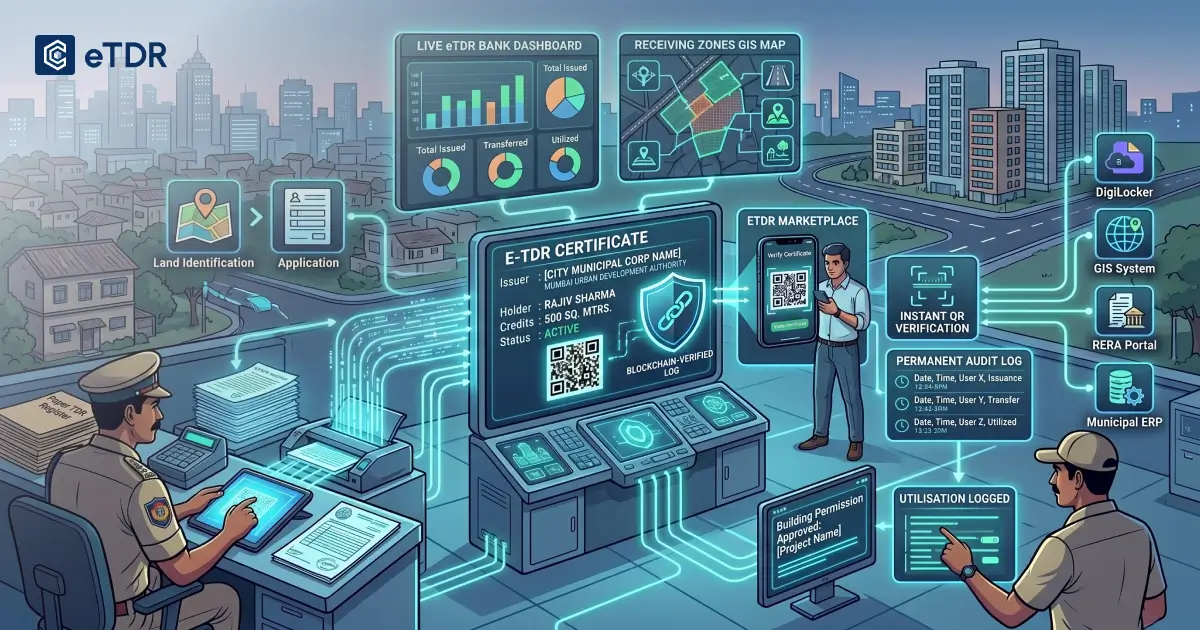
An e-TDR platform replaces the fragmented paper trail with a single authoritative record. The Development Rights Certificate management process shifts from a multi-department paper exercise into a single digital workflow.

Here is what a digital TDR system changes at each stage:

  • Issuance: Each certificate is issued as a blockchain-anchored digital credential. The record cannot be altered after issuance.
  • Transfer: Every transfer is logged with a timestamp, actor identity, and reference to the original certificate. Ownership history is complete and permanent.
  • Pricing: Transaction data on a regulated platform creates pricing benchmarks visible to all market participants.
  • Utilisation: Building permits and TDR records exist within the same system. Every utilisation connects back to the issuing authority automatically.
  • Verification: Any authorised party can verify a certificate instantly using a QR code or unique certificate ID. No office visit is required.
  • Audit: Every officer action, every approval, and every transfer is logged on the blockchain. The record is immutable and immediately available for compliance review.

The full e-TDR lifecycle becomes traceable from land identification to final utilisation in a single system.

What Commissioners and Urban Planners Can Finally See in Real Time

In a paper TDR system, a city commissioner asking “how much TDR is currently in circulation?” cannot get an accurate answer without days of manual reconciliation across multiple departments. A digital TDR system produces this data immediately.

What municipal corporations and urban development authorities gain:

  • A live dashboard showing total TDR issued, transferred, in active use, and expired across the entire city.
  • Zone-level data showing which receiving areas are absorbing high TDR volume against infrastructure capacity.
  • A complete, timestamped audit log for every certificate, every officer action, and every approval at each workflow stage.
  • RTI and CAG-ready records that require no manual preparation before submission.
  • Multi-level approval visibility from junior engineer through to commissioner, with e-signatures at every step.

For Smart City Mission teams, this smart city alignment between TDR administration and digital governance standards is directly relevant. The National Urban Digital Mission requires Urban Local Bodies to meet open data and interoperability standards. A digital TDR system produces structured, timestamped data that satisfies these requirements from within the normal workflow.

Why Real Estate Developers Are Paying More Than They Should for TDR

The World Bank has identified transparent, liquid TDR markets as essential for the instrument to function as effective urban infrastructure finance. That transparency does not currently exist when transactions are brokered privately and price data remains undisclosed.

Developers operating in opaque TDR markets face three direct costs:

  • Information asymmetry: Sellers and buyers do not have equal access to pricing data. Intermediaries capture the gap.
  • Verification risk: A developer cannot confirm a certificate’s authenticity before purchase without visiting a municipal office, which adds time and cost to every transaction.
  • Approval delays: Manual TDR verification at the building permission stage delays project timelines.

A digital TDR system creates a structured market with visibility for all participants. An online TDR marketplace lists available e-TDR certificates with verified details, published transaction records, and direct transfer on a regulated platform. Certificate availability, pricing, and transfer happen with a complete record of every transaction. Developers reduce dependence on intermediaries and submit e-TDR credentials directly at the building permission stage.

How e-TDR Makes Regulatory Compliance a Built-In Process

In a paper TDR system, regulatory compliance requires collecting records from multiple departments and reconciling them manually. A digital TDR system produces compliance as a standard output of the issuance and transfer workflow.

  • RERA filings that require TDR documentation are supported by verified digital credentials that match the project record directly.
  • Court proceedings involving disputed certificates have access to an immutable blockchain record with complete provenance history.
  • The approval chain from initial application to final issuance is logged at every stage. No reconstruction of records is needed for a legal dispute or regulatory inquiry.
  • Inter-city and inter-state verification becomes possible because e-TDR certificates issued on standardised platforms can be verified by any authorised authority.

This is the practical governance outcome of a complete digital TDR system: every action that matters is recorded, verifiable, and permanently available to the parties who need it.

EveryCRED eTDR is for the Accountability Standard Indian Cities Need

Municipal corporations and urban development authorities managing TDR through paper records carry structural transparency gaps that staffing and process improvements cannot resolve. We built the EveryCRED eTDR platform to close these gaps at the system level.

The platform issues tamper-proof TDR certificates as blockchain-anchored verifiable credentials, tracks every transfer with a permanent audit trail, and gives commissioners and town planners a live eTDR Bank dashboard across all city zones. Multi-level approval workflows, e-signatures at every stage, QR-based instant verification, and a regulated eTDR marketplace are all part of a single government-grade system. Alignment with DigiLocker, RERA portals, GIS systems, and municipal ERP software means EveryCRED eTDR works within the infrastructure cities already use.

If your city is ready to move TDR administration from paper registers to a fully auditable digital record, speak with our team to understand what implementation looks like for your jurisdiction.

Conclusion

Transparency in TDR is what makes the instrument function as intended. When issuance, transfer, pricing, and utilisation are visible to the right parties at the right time, TDR works as a reliable land acquisition tool that both governments and developers can trust. A digital TDR system is the infrastructure that makes this possible. Cities that adopt it gain not just efficiency but the kind of documented accountability that paper records cannot provide.
How to Sell TDR Rights Online: What Landowners and Cities Must Understand First

A Development Rights Certificate (DRC) is a government-issued instrument with real economic value. When a landowner surrenders land for a public purpose, the issuing municipal authority provides a TDR certificate in exchange. That certificate represents buildable floor space that the holder can either use on another eligible plot or sell to a developer who needs it. 

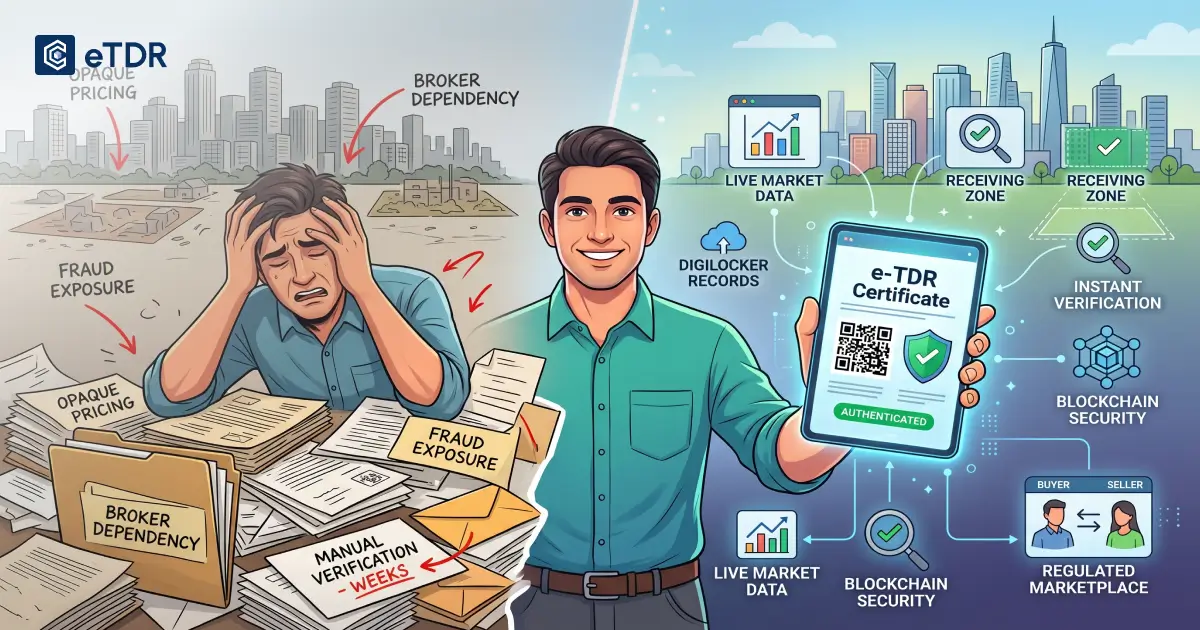
Most landowners who hold TDR have found the process of selling it frustrating. Pricing is opaque. Buyers are hard to find without a broker. Verification takes weeks. None of this is inherent to how TDR works as a policy instrument. It is the result of managing a modern financial entitlement through paper and manual processes. 

This article explains what it actually takes to sell TDR rights online, the legal requirements involved, and how India is building the infrastructure to make this work at scale. 

What It Actually Means to Sell TDR Rights 

Selling TDR rights means transferring a legal entitlement to additional floor space from one party to another. The buyer gains the right to build beyond the permitted FSI in a designated receiving zone. The seller receives compensation at a price set by demand and supply. No government-fixed rate applies. 

A few rules govern every TDR sale: 

  • A certificate can be sold in full or in parts 
  • Once fully sold or utilised, the certificate becomes null and void 
  • Every TDR transfer requires a registered deed and applicable stamp duty 
  • The buyer’s receiving plot must fall within a zone designated to accept TDR under the local Development Control Regulations 

Understanding the difference between TDR and FSI matters here. FSI is fixed to a single plot. TDR travels between plots across approved zones. A seller must confirm zone eligibility before agreeing to any transaction. 

Why Selling TDR on Paper Has Never Worked 

The paper-based TDR system creates three consistent problems for sellers. 

Pricing Without Benchmarks 

There is no public record of what similar certificates have sold for. Sellers have no reference point and routinely receive below-market compensation because brokers control transaction information. 

Fraud Exposure 

Physical DRCs can be forged or sold to multiple buyers before the issue is detected. A single fraudulent certificate can be submitted in multiple building approval processes simultaneously. The seller may receive payment while the buyer later discovers the certificate has no standing. 

Verification That Stalls Transactions 

A buyer’s legal team or approving authority must manually confirm a paper certificate’s validity, remaining balance, and zone eligibility. This process takes days or weeks. Projects wait. Deals collapse. 

The NITI Aayog TDR Guidelines explicitly call for a robust mechanism to prevent fraudulent transactions and enhance the commercial value of TDR certificates. The guidelines also recommended that urban local bodies establish online TDR banks to reduce broker dependency and improve pricing transparency. 

The Prerequisite Nobody Talks About: Digitise the Certificate First 

You cannot sell TDR rights online if your certificate is on paper. This is the step most sellers overlook. 

When GHMC launched India’s first online TDR Bank in February 2020, it made digital conversion mandatory for all existing manual certificate holders before any online transaction could proceed. The same condition applies wherever digital TDR systems are implemented. 

An e-TDR certificate is a blockchain-anchored digital credential. It carries a unique cryptographic identifier. It cannot be duplicated or altered after issuance. Its ownership history is fully traceable. 

If your certificate was issued on paper, the first action is to approach the issuing municipal authority and request conversion to a digital format. Without this step, no online listing, transfer, or verification is possible. 

How to Sell TDR Rights Online: The Step-by-Step Process 

The sequence below applies across cities that operate digital TDR systems, with state-level variations in documentation. 

Step 1: Verify Certificate Status 

Confirm the remaining balance, zone classification, and that the certificate is in digital or converted form. A partially utilised certificate carries only its remaining available area. 

Step 2: Access the Platform 

The issuing municipal authority provides login credentials to TDR holders. These credentials give access to the online TDR bank or marketplace where the certificate can be listed. 

Step 3: Create a Listing 

Upload the certificate details, available area, zone classification, and asking price. Platforms with live market data allow sellers to compare their certificate against active listings in the same zone before setting a price. 

Step 4: Connect with a Buyer 

Buyers search available certificates by zone, area, and price. On a regulated digital platform, both parties access the same verified data. There is no intermediary controlling information flow. 

Step 5: Execute a Registered Transfer 

Formalise the transaction through a registered deed. Stamp duty and registration fees apply under state rules. In Telangana, for example, an agreement on stamp paper is mandatory under GO Ms. No. 330. 

Step 6: Record the Change 

The platform updates ownership. The buyer’s identity links to the certificate. The seller’s balance updates or closes depending on whether the sale was full or partial. 

The complete e-TDR certificate lifecycle, from issuance to transfer to final utilisation, is tracked on a properly built digital platform at every step with timestamps and actor records. 

Four Legal Checks Before Any TDR Sale 

Before you proceed to sell TDR rights, confirm the following: 

  1. Zone eligibility: The buyer’s receiving plot must fall in a designated receiving zone under the applicable Development Control Regulations 
  1. RERA disclosure: If the certificate will be used in a registered real estate project, the promoter must disclose TDR utilisation at RERA project registration as required under the Real Estate (Regulation and Development) Act, 2016 
  1. Registered deed: An unregistered agreement has no legal standing; registration is mandatory at every stage 
  1. Certificate balance: Confirm the exact available area before agreeing to any price or quantity 

How India Is Building the Infrastructure for Online TDR Transactions 

The policy direction is clear. MoHUA included TDR in its Value Capture Finance Policy Framework in 2017. NITI Aayog issued national TDR guidelines in 2021. The World Bank identified fraud prevention and market transparency as the two essential conditions for TDR to function as a bankable instrument in Indian cities. 

The Digital India Land Records Modernisation Programme (DILRMP) has now digitised 98.5% of rural land records and assigned Unique Land Parcel Identification Numbers to over 23 crore land parcels across India. This creates the digital land administration foundation on which e-TDR systems are built. 

GHMC’s TDR Bank was cited by NITI Aayog as a national model. Several states are now evaluating similar systems for their municipal bodies. 

What a Digital TDR Platform Changes for Each Stakeholder 

A TDR management system built on digital infrastructure changes outcomes across the board. 

Landowners and sellers get live market pricing data. They know what their certificate is worth before entering any negotiation. Broker dependency ends. 

Developers and buyers get instant verification. Certificate authenticity, available balance, and zone eligibility are confirmed in seconds rather than days. Building approval timelines shrink when manual cross-checks are replaced by real-time digital confirmation. 

Municipal Corporations get a real-time TDR bank showing total FSI credits issued, available, transferred, and utilised across the city. Town planners make density and zoning decisions with accurate live data. 

Banks and legal teams get tamper-proof audit trails that make TDR certificates verifiable for loan collateral assessment and dispute resolution. 

EveryCRED eTDR Is Created for the Authorities That Enable TDR Transactions 

Municipal Corporations and Urban Development Authorities that want to enable verified online TDR transactions need the right digital infrastructure in place first. 

EveryCRED eTDR provides a complete platform for the full e-TDR lifecycle. Digital certificate issuance runs through configurable multi-level approvals with e-signatures at each stage and automatic blockchain anchoring at issuance. A central eTDR Bank tracks real-time status across every certificate in the city. A regulated marketplace lets certificate holders list and buyers transact with built-in compliance checks. Any party, including developers, banks, and courts, can verify a certificate’s authenticity instantly via QR code or unique certificate ID. 

The platform is built on W3C Verifiable Credentials standards and integrates with DigiLocker, RERA portals, GIS systems, and municipal ERP software. Certificates issued by one municipal body are verifiable by any other authority on the same system. 

Authorities ready to move beyond paper-based TDR management can explore the EveryCRED eTDR platform and request a working demo from our experts. 

Conclusion 

Selling TDR rights online is achievable. The legal framework exists. The policy support is in place. The technology is deployed in Indian cities. 

Three conditions must be met: the certificate must be in digital format, the issuing authority must operate a compliant digital TDR platform, and the transfer must follow the required legal process including a registered deed and applicable RERA disclosures. 

For landowners, this sequence removes broker dependency and opens direct access to a transparent market. For Municipal Corporations and Urban Development Authorities, building this infrastructure means faster land acquisition, accurate planning data, and a TDR programme that performs as designed. 

What Is Transferable Development Rights (TDR)? India’s Urban Planning Tool Explained

India’s cities are expanding fast. Roads need widening. Parks need land. Schools and drainage systems require space that is currently privately owned. Governments must acquire this land to build public infrastructure. Cash compensation is the traditional method, but in dense urban areas, it is slow, expensive, and legally contested. 

Transferable development rights (TDR) offer a different path. Instead of paying cash, a municipal authority issues the landowner a legal entitlement to build additional floor space elsewhere in the city. That entitlement can be used on another plot or sold to a developer who needs it. 

TDR was first introduced in Mumbai in 1991. Cities such as Hyderabad, Pune, Ahmedabad, and Bengaluru have since adopted their own TDR frameworks. The Ministry of Housing and Urban Affairs (MoHUA) included TDR in its Value Capture Finance Policy Framework in 2017. NITI Aayog issued formal TDR guidelines in 2021, providing a national framework for states and urban local bodies to follow. 

The Government Tool That Acquires Land Without a Cash Payout 

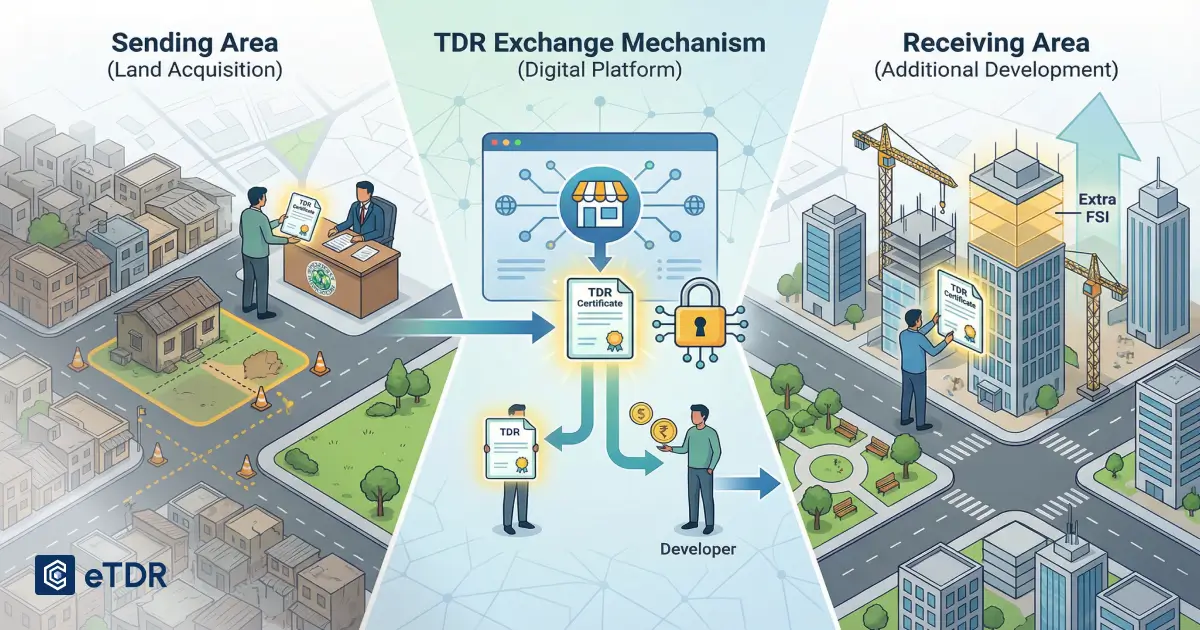
When a municipal corporation identifies land needed for a public project, it approaches the landowner. If the land is surrendered, the authority issues a Development Rights Certificate (DRC), also called a TDR certificate. This certificate represents a defined quantum of buildable floor space, measured in square metres. 

The certificate holder has two options: 

  • Use it directly: Apply the DRC on another plot in a designated receiving zone to build beyond the standard Floor Space Index (FSI) 
  • Sell it: Transfer the DRC to a developer who needs additional FSI on their construction project 

The government secures the land it needs for public use. The landowner receives real economic value. The developer gains additional buildable area. No large cash outflow from the government budget is required. 

Who Is Actually Involved in a TDR Transaction 

Transferable development rights involve four parties at every stage. 

The Issuing Authority 

Municipal corporations and urban development authorities identify sending areas, verify ownership, process applications, and issue TDR certificates. They also designate receiving zones where TDR can be applied. 

The Landowner 

The person in the sending area who surrenders land for a public purpose. They receive a DRC and choose whether to use it or sell it. 

The Developer 

Developers purchase TDR certificates to unlock additional FSI on their projects, beyond what standard regulations allow in the receiving zone. 

The Regulatory Framework 

Each state defines sending zones, receiving zones, FSI multipliers, and transfer procedures through its Development Control and Promotion Regulations (DCPR) or equivalent rules. These rules govern every TDR transaction in that jurisdiction. 

Why India’s Fast-Growing Cities Cannot Function Without TDR 

India’s urban population is projected to reach 42% of the total population by 2030, up from 31% in 2011. Urban local bodies (ULBs) across India face a persistent shortage of funds for infrastructure. Land acquisition is among the costliest components of any urban project. 

According to a World Bank analysis of India’s urban financing world, TDR provides municipal authorities the flexibility to compensate landowners through Development Rights Certificates at present market value without requiring any actual cash outflow. This is why TDR has become a central instrument in India’s urban planning toolkit. 

TDR serves multiple public purposes: 

  • Road widening and new road corridors 
  • Parks, playgrounds, and open green spaces 
  • Public and affordable housing development 
  • Heritage building conservation 
  • Slum rehabilitation and redevelopment 

Several cities have built active TDR markets. The Greater Hyderabad Municipal Corporation (GHMC) established an online TDR bank that connects buyers and sellers with transparent pricing. In Mumbai, over 7.5 million square metres of slum TDR were traded by developers over two decades. In Ahmedabad, nearly Rs 370 crore worth of TDR was transacted for the conservation of 2,236 private heritage structures in the walled city. 

Paper TDR Certificates Are Holding Indian Cities Back 

Despite solid policy logic, TDR has underperformed in many cities. The paper-based management system is the primary reason. 

Problems with paper TDR are well-documented: 

  • Fraud and forgery: Physical DRCs are vulnerable to duplication and forgery. Fake certificates delay building approvals and create disputes that consume years in resolution 
  • No central registry: Most cities lack a single record of all issued, transferred, and utilized TDR. This creates information gaps that benefit brokers over landowners and developers 
  • Opaque pricing: Without a transparent marketplace, TDR pricing is controlled by intermediaries with information advantages 
  • Slow verification: Verifying a paper DRC requires physical visits and manual checks. Building approvals are delayed as a result 
  • Limited access for small landowners: Without a regulated marketplace, individual DRC holders struggle to find buyers or assess fair pricing 

These are structural limitations of paper. Better administration and additional staff cannot resolve them. The medium itself is the problem. 

eTDR Is Replacing Paper with Tamper-Proof Digital Certificates 

eTDR is the digital version of transferable development rights. It converts paper DRCs into blockchain-anchored digital credentials. Each certificate is cryptographically secured, timestamped, and permanently recorded. It cannot be duplicated or altered after issuance. 

The shift from paper TDR to e-TDR changes the process at every stage: 

  • Issuance: Officers create digital TDR certificates through a multi-level approval workflow, with e-signatures required at each stage 
  • Transfer: Every transfer is recorded digitally with a complete ownership trail from first issuance to final utilization 
  • Verification: Any party can verify a certificate instantly using a QR code or unique ID. No office visit is required 
  • Marketplace: A regulated digital marketplace connects DRC holders with developers and displays real-time pricing 
  • Reporting: City authorities access dashboards showing total TDR issued, available, transferred, and utilized across the entire city at any given time 

The full eTDR lifecycle from land identification to final certificate verification becomes traceable, auditable, and tamper-proof. Every action by every officer is logged with timestamps and cannot be removed from the record. 

EveryCRED eTDR: The Platform Built for India’s Municipal Corporations 

EveryCRED e-TDR is a purpose-built platform for municipal corporations, urban development authorities, and smart city mission teams. It covers the complete digital TDR management cycle, from certificate issuance to marketplace transactions and real-time verification. 

Core platform capabilities: 

  • eTDR Issuance Platform: Issue digital TDR certificates with configurable multi-level approvals and automatic blockchain anchoring 
  • eTDR Bank: A central digital repository tracking all certificates by status, including pending, issued, transferred, utilized, and blocked 
  • eTDR Marketplace: A regulated platform where landowners list certificates and developers purchase them with built-in compliance checks 
  • City Map View: An interactive GIS map of all TDR-linked parcels with zone classifications, area measurements, and supporting document references 
  • Instant Verification Portal: Open access verification for officials, developers, courts, and banks using a QR code or certificate ID 

The platform is built on W3C Verifiable Credentials standards. It integrates with DigiLocker, RERA portals, GIS systems, and municipal ERP software. TDR certificates issued by one municipal body can be verified by any other authority through the same system, enabling inter-city and inter-state compatibility. 

Municipal corporations and urban development authorities looking to replace paper-based TDR processes can explore the digital TDR management platform and request a working demo. 

Conclusion: The Policy Is Sound. The System Managing It Must Follow

Transferable development rights have decades of proven use across Indian cities. The concept delivers fair compensation to landowners, reduces government cash outflow, and enables planned urban development. The limitation has never been the policy itself. It has been the paper systems used to implement it. 

e-TDR closes that implementation gap. Cities that adopt digital TDR management can issue certificates faster, eliminate fraud, verify instantly, and operate a transparent market for development rights. For India’s municipal corporations and urban planners, this is not an optional improvement. It is the operational baseline that the pace of urbanization now requires.