India’s cities are building roads, parks, drainage systems, and public infrastructure at a pace that demands a faster approach to land acquisition. The Smart Cities Mission has pushed 100 cities toward technology-led urban administration. The National Urban Digital Mission is extending digital infrastructure to over 4,800 urban local bodies. Land records are being digitised at the national level through DILRMP.
Yet Transferable Development Rights, one of the most widely used tools for government land acquisition, still runs on paper in most Indian cities. That gap matters. A dedicated smart city TDR platform is what bridges it.
TDR Is Still Failing Cities That Have Gone Digital
City governments have successfully digitised property tax, water billing, and grievance systems. TDR management has not kept pace. The consequences show up across every stakeholder in the process.
Development Rights Certificates (DRCs) issued on paper can be forged, duplicated, and sold to multiple buyers. Pricing is set privately through broker networks with no public visibility. Municipal officers verify TDR holdings by cross-checking physical files, a task that can take days or weeks. City planners have no reliable data on how much TDR has been issued, transferred, or consumed across zones.
These are not administrative inefficiencies that better staff management can fix. They are structural failures that slow infrastructure delivery, distort land markets, and reduce public trust in the urban planning process.
Understanding what TDR is makes it immediately clear why managing it digitally is not optional for cities with serious infrastructure pipelines.
What “Smart City Ready” Actually Means for a TDR Platform
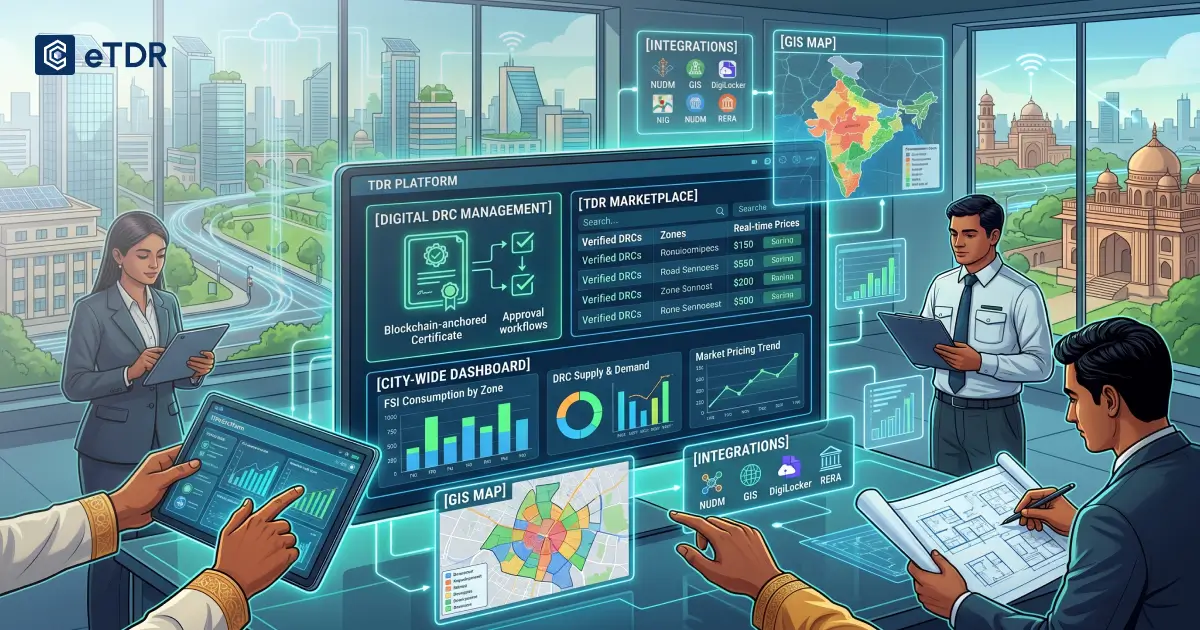
A smart city TDR platform is not a scanned version of a paper process. It is a live, connected system that gives every participant in the TDR ecosystem, from the issuing officer to the developer using DRCs in a building approval, accurate information at the right moment.
A platform qualifies as smart city-ready when it does the following:
- Issue DRCs digitally with multi-level approval workflows and e-signatures at each stage
- Anchors every certificate on blockchain, making records tamper-proof and permanently traceable
- Operates a regulated digital marketplace where landowners and developers transact directly
- Automates TDR verification during building approvals, including zone eligibility checks and utilisation deductions
- Provides real-time dashboards showing DRC supply, market pricing, and FSI consumption by zone
- Integrates with GIS systems, RERA portals, DigiLocker, and municipal ERP software
- Supports inter-city and inter-state certificate recognition, so a DRC issued by one authority is verifiable by another
How this works in practice across the roles of issuer, seller, and buyer follows a structured and fully auditable sequence on a well-built e-TDR system.
The Four Groups That a TDR Platform Must Actually Serve
Every TDR transaction involves multiple parties. A platform built for only one of them creates friction for the others.
-
Municipal Corporations and Urban Development Authorities
These bodies issue DRCs when landowners surrender land for public projects. On a smart city TDR platform:
- Issuance is digital, with automatic blockchain anchoring on final approval
- Every action, from land identification to certificate issuance, is timestamped and auditable
- A central dashboard gives administrators a live view of all issued, active, transferred, and utilised TDR in the city
Cities managing digital TDR at scale gain direct operational control over the DRC lifecycle without relying on manual registers or physical files.
-
Smart City Mission Teams
Urban planning teams need reliable data to make decisions on density, zoning, and infrastructure investment. A smart city TDR platform gives them:
- Zone-level DRC supply and demand visibility
- Historical and current market pricing by receiving zone
- FSI consumption data broken down by area and approval type
- Early signals on which zones face supply shortfalls
-
Real Estate Developers
Developers need TDR to increase FSI on their projects. On a digital marketplace, they can browse verified DRC listings by zone and area, purchase directly without broker involvement, and receive automatic TDR verification during building plan submissions.
For a clear explanation of how to access and transact on the market, selling TDR online follows a structured process that removes the pricing opacity and delays that defined the paper-based system.
-
Landowners
Landowners who surrender land receive DRCs as compensation. On an e-TDR platform, they list certificates directly, set an asking price, and track offers in real time, without depending on brokers or navigating informal markets.
India’s Digital Governance Framework Already Points Here
The policy environment in India is designed to support this kind of platform.
The National Urban Digital Mission (NUDM), launched in 2021 by the Ministry of Housing and Urban Affairs, aims to build shared digital infrastructure across all urban local bodies. It promotes open, interoperable platforms for municipal services, from property tax to building approvals, working across three pillars: people, process, and platforms.
A smart city TDR platform built on open standards connects directly to this infrastructure. It integrates with the same tools cities are already building: Aadhaar-linked identity, DigiLocker for verified document access, and RERA for real estate compliance. The technical architecture of an end-to-end e-TDR platform is designed to fit within this national digital stack, not sit outside it.
The Data Layer Is What Changes Urban Planning Decisions
The most important feature of an e-TDR platform is not the transaction system. It is the data that the platform generates.
When TDR runs on paper, planning departments have no reliable aggregate view of the market. Decisions on zoning, density, and infrastructure budgeting happen without knowing how much TDR has been issued, where it is concentrated, or at what prices it is trading.
On a smart city TDR platform, planning teams can access:
- Total DRC area issued versus total utilised, citywide and by zone
- Current market pricing trends for TDR across receiving zones
- Which zones face supply shortfalls relative to development demand
- The rate at which issued certificates are moving through the market into building approvals
This data directly supports decisions on where to allow higher density, how much infrastructure the city can fund through TDR, and whether the current policy is producing its intended outcomes. Understanding e-TDR as a connected system, rather than a certificate format, clarifies why the data layer is as important as the transaction layer.
EveryCRED eTDR is Built for Cities That Need This to Work
We built the EveryCRED e-TDR platform for Municipal Corporations, Urban Development Authorities, and Smart City Mission teams that are ready to run a live digital TDR program, not a pilot.
Here is what the platform delivers:
- Full DRC lifecycle management from issuance through transfer, utilisation, and verification
- Blockchain-backed certificates built on W3C Verifiable Credentials, ensuring records that cannot be altered or duplicated
- A regulated digital marketplace where DRC holders and developers transact directly, with full pricing transparency
- Automated building approval integration for real-time TDR verification, reducing approval timelines from weeks to seconds
- Real-time dashboards for administrators and planning officials, covering supply, demand, pricing, and FSI consumption
- Integration with DigiLocker, RERA, GIS systems, and existing municipal ERPs
- Inter-city and inter-state interoperability, so a DRC issued by one authority is accepted by another
- Multi-level approval workflows with e-signatures, from Junior Engineer to Commissioner
We configure the platform to your city’s regulatory framework, zone structure, and existing workflows. No new IT department. No system overhaul. Your team brings the mandate. We bring the platform.
If your organisation is currently managing TDR through paper certificates, manual registries, or disconnected systems, reach out to us. We will walk you through what a fully operational smart city TDR program looks like in practice.
Conclusion
India has the policy direction, the digital infrastructure, and the governance mandate to transform how cities manage Transferable Development Rights. The Smart Cities Mission, NUDM, and DILRMP have established the foundation. What has been missing is a purpose-built smart city TDR platform that connects issuance, trading, verification, and planning data into a single, auditable system.
That platform exists. The question now is adoption. Mumbai has already adopted it.
Cities that digitise TDR management gain faster land acquisition, fraud-proof certificates, transparent DRC markets, and the planning data they need to make better decisions. Those that continue on paper will continue to face the same delays, disputes, and opacity that have limited TDR’s effectiveness for decades.
Leave a Reply