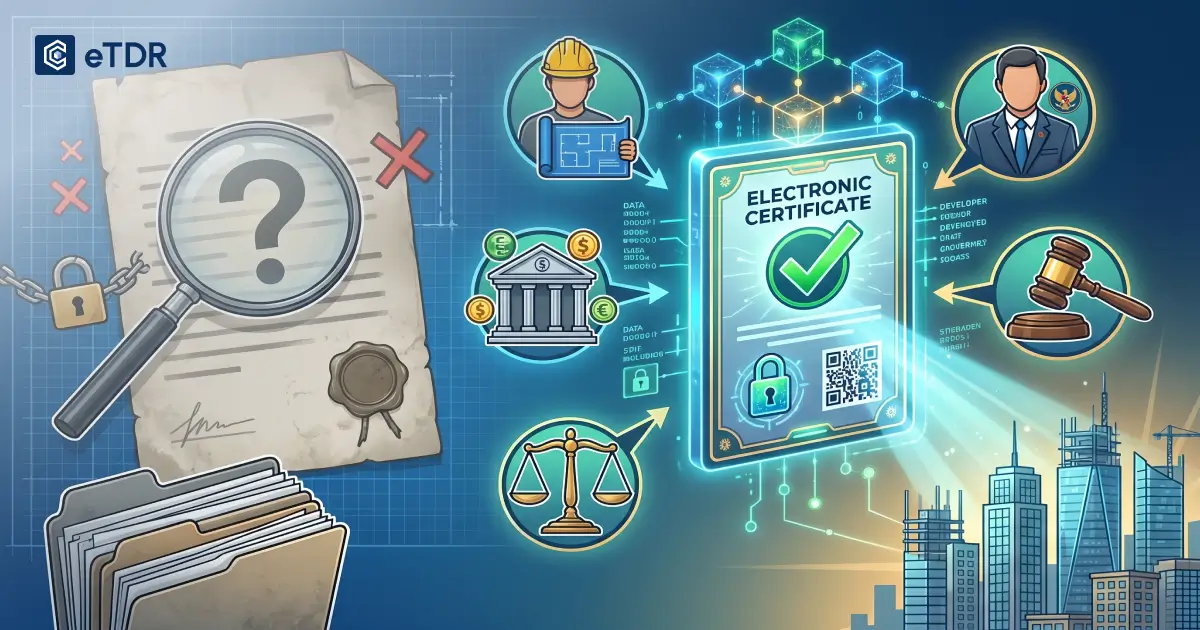
A TDR certificate carries real monetary value. In cities like Mumbai, Hyderabad, and Pune, a single Development Rights Certificate can represent crores in floor space credit. Despite this, most buyers, lenders, and planning officers have no reliable method to confirm whether a certificate is genuine before a transaction completes.
TDR certificate verification is now a fundamental requirement for anyone who issues, purchases, transfers, or processes development rights in India. Here, we have explained what verification means in practice, who needs it, and how a digital system makes it work.
A Scanned PDF Is Not a Verified TDR Certificate
This is the most common misconception in the TDR market. A scanned copy of a certificate proves nothing. A PDF can be copied, altered, or submitted to multiple building authorities before anyone detects the error.
True TDR certificate verification confirms:
- That the certificate was issued by a recognised authority
- That the issuing officer’s digital signature is cryptographically valid
- That the FSI credit is intact and not partially or fully consumed
- That the certificate is not blocked, under dispute, or already pledged elsewhere
Understanding what eTDR is explains the distinction clearly. A digital TDR credential is not a scanned image of a paper document. It is a cryptographically anchored record that any authorised party can verify in real time.
Four Parties Who Cannot Afford a Verification Failure
TDR certificate verification is not a single-stakeholder concern. Each party in the transaction carries a different kind of exposure.
1. Real Estate Developers
Developers purchase TDR to unlock additional FSI on receiving plots. A forged or already-utilised certificate means paying market price for a right that cannot be applied. Before buying TDR, every developer must confirm authenticity, zone eligibility, and available FSI balance.
2. Municipal and Planning Officers
At the building permission stage, officers must confirm that the DRC submitted is genuine, belongs to the applicant, and has not been applied to another project. Manual verification against physical records takes days and still carries error risk.
3. Banks and Financial Institutions
Lenders accepting TDR as collateral must confirm the certificate is valid, unencumbered, and legally held by the borrower. Without a live verification mechanism, most banks cannot accept TDR as security.
4. Courts and Legal Professionals
In disputes, the audit trail behind a TDR certificate must be complete and tamper-proof. A physical register does not satisfy requirements under RTI or CAG review.
Why Paper-Based TDR Verification Consistently Fails
The NITI Aayog TDR guidelines call explicitly for a robust mechanism to prevent fraudulent transactions and enhance the commercial value of Development Rights Certificates. The paper system cannot meet this requirement.
The failures are structural:
- A physical DRC can be duplicated and submitted to multiple building approvals simultaneously
- No central registry confirms whether a certificate is active, transferred, or fully consumed
- Manual verification requires an officer to cross-check physical files, which takes days or weeks
- Landowners receive below-market prices because intermediaries control information that certificate holders cannot independently access
- Lost or damaged certificates require legal proceedings to replace
These are failures of the paper medium, not failures of administration. Reliable TDR management at city scale requires a live digital registry, instant verification, and an immutable audit trail from issuance to utilisation.
What a Digitally Verifiable TDR Certificate Actually Contains
When TDR certificate verification runs on a properly built digital platform, the result returns a complete data record. Each verified e-TDR certificate reveals:
- The issuing municipal authority and the date of issuance
- The identity and ownership history of DRC holders
- The FSI credit amount in square metres
- The sending zone from which the TDR was generated
- The receiving zones where it can be applied
- The current certificate status: Issued, Transferred, Utilised, or Blocked
- Complete transfer history with timestamps
- Whether the certificate is under any dispute, lien, or block
This data is secured on the blockchain and cannot be altered after issuance. The entire e-TDR lifecycle from land identification to final utilisation is recorded, making every verification result fully defensible in regulatory and legal proceedings.
Step by Step: How Digital TDR Certificate Verification Works
The verification process on a properly built e-TDR platform is direct. No office visit is required.
- The verifier accesses the public verification portal or scans the QR code printed on the e-TDR certificate
- The system retrieves the blockchain record using the unique certificate ID
- The verifier sees the complete certificate data: holder identity, FSI balance, zone eligibility, and current status
- If the certificate is valid and unencumbered, the verifier proceeds with the transaction or approval
- The verification event is logged with a timestamp and stored permanently on the blockchain
The entire process takes seconds. This is what a digital TDR platform makes possible for every party in the TDR ecosystem.
RERA Is Turning TDR Verification into a Regulatory Requirement
Legal and compliance practitioners who work with DRCs have flagged that verification requirements for TDR are tightening. Practitioner recommendations include assigning a unique identification number and QR code to every DRC so stakeholders can verify origin, holder identity, and unused FSI balance at any point. Proposed frameworks also include integrating DRC verification directly with GIS-based land records and building approval systems.
For developers using TDR in a RERA-registered project, full disclosure of DRC usage to allottees is mandatory. A certificate that cannot be independently verified by allottees or regulators weakens that disclosure obligation. An electronic TDR platform that issues verifiable credentials satisfies this requirement at the point of issuance.
What Verified TDR Enables That Paper TDR Cannot
When TDR certificate verification is instant and reliable, the outcomes are direct and measurable across every stakeholder group.
For developers:
- Building approvals process faster because verified DRC submissions clear without manual cross-checks
- Certificate authenticity is confirmed before purchase, eliminating the risk of fraud
For landowners:
- Fair market pricing is achievable when buyers can independently confirm what they are purchasing
For municipal corporations:
- Fraud risk is reduced without increasing administrative overhead
- Audit requirements are satisfied automatically through the immutable blockchain record
For banks:
- TDR can be accepted as security because certificate status is verifiable in real time
For courts and regulators:
- Complete tamper-proof records are available for any certificate ever issued
A verifiable e-TDR certificate functions as a financial instrument. A paper certificate with no verification mechanism is a legal liability.
EveryCRED eTDR Delivers Instant, Reliable Verification for Every Stakeholder
We built EveryCRED eTDR specifically to make TDR certificate verification immediate and accessible for every authorised party in the ecosystem. The platform provides:
- Instant verification via QR code or unique certificate ID, accessible to developers, banks, courts, and planning officers
- Real-time certificate status across all states: Issued, Transferred, Utilised, and Blocked
- Complete provenance data covering issuing authority, holder history, FSI balance, and zone eligibility
- Immutable audit trail for every approval, transfer, and verification event
- Cross-authority compatibility so an e-TDR certificate issued by one municipal body is verifiable by any other authority on the same network
- Integration with DigiLocker, RERA portals, and GIS systems
Municipal corporations, urban development authorities, and smart city mission teams looking to move to verifiable e-TDR issuance can request a working demo of the EveryCRED eTDR platform.
Conclusion
TDR certificate verification is a practical requirement for every party that issues, buys, transfers, or processes development rights in India. Paper systems cannot deliver the verification standard that developers, banks, planning officers, and regulators require today. A properly built e-TDR platform issues certificates that any authorised party can verify in real time, with a complete audit trail and no dependency on manual records. The policy framework from NITI Aayog supports this direction. RERA compliance reinforces it. For each urban body and development team, the question is no longer whether to shift to digital TDR certificate verification. It is how quickly implementation begins.