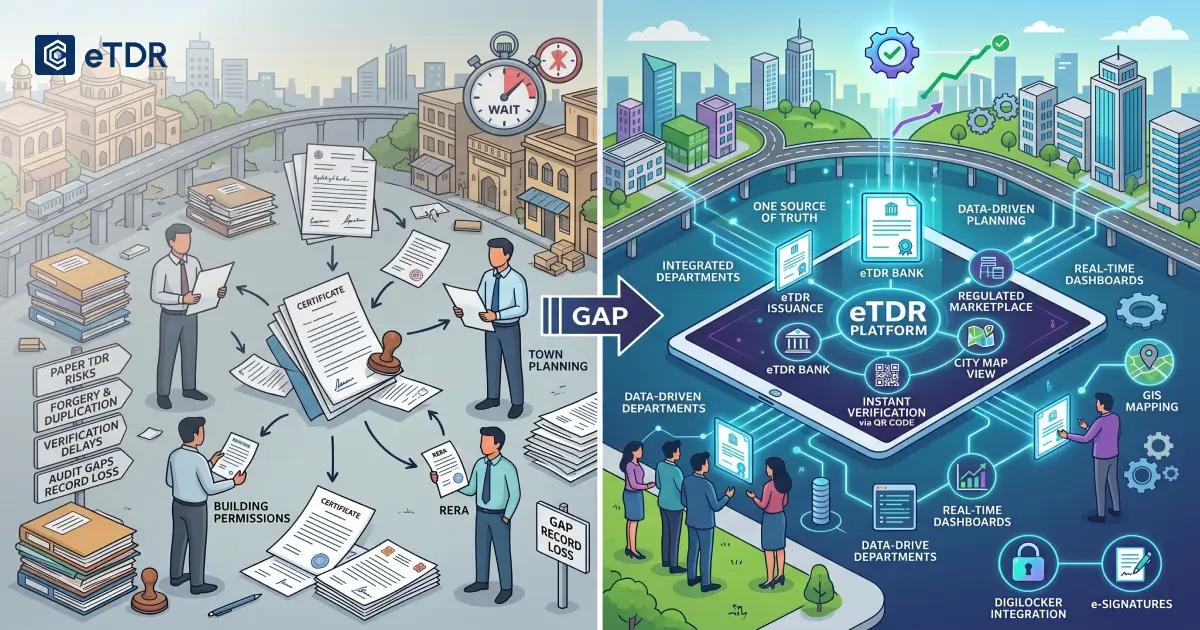
India’s cities are acquiring land at a rate that demands faster, more reliable administration. Roads, drainage corridors, parks, and public housing projects all require private land. Municipal bodies issue Transferable Development Rights certificates to compensate landowners who surrender that land for public use. The policy enabling this process is well-established at both the national and state levels. In most Indian cities, the administration supporting it is still paper-based. That is a governance gap, and it sits directly with municipal corporations and urban development authorities.
The Policy Is Ready. The Execution Is Not.
India’s national TDR policy framework calls explicitly for a robust mechanism to prevent fraudulent transactions and enhance the commercial value of TDR certificates. The Ministry of Housing and Urban Affairs included TDR as a primary Value Capture Finance method for delivering infrastructure without cash payouts.
The framework exists. What most cities are missing is the operational infrastructure to execute it. TDR functions as a proven urban planning tool across dozens of Indian cities. Yet the administration behind it still depends on physical certificates, manual verification, and paper registers. That gap between policy intent and administrative reality is where governments carry the highest cost.
A digital TDR platform is what closes this gap.
Paper TDR Puts Municipal Bodies at Legal and Audit Risk
Physical TDR certificates carry risks that fall directly on the issuing authority. Staffing improvements alone cannot resolve them. These are structural problems of the paper medium.
- Forgery and duplication: A paper certificate can be copied and submitted to multiple building applications before any authority detects it. The issuing body carries the legal exposure when this happens.
- No defensible audit trail: Courts, the Comptroller and Auditor General, and RTI applicants can request a complete record of TDR issuance, transfer, and utilisation. A physical register does not satisfy this requirement.
- Verification delays: Manual cross-checking of paper files takes days or weeks. This slows building approvals and delays infrastructure delivery that TDR was issued to fund.
- Record loss: Replacing a damaged or lost TDR certificate requires legal proceedings that consume time from both the landowner and the issuing authority.
A digital TDR platform addresses each of these exposures at the system level. Effective TDR management at city scale requires digital certificate issuance, immutable audit logs, and instant verification as baseline capabilities.
Four Departments, Four Versions of the Same Record
TDR administration spans at least four municipal departments. Each holds a separate fragment of the process:
- The Revenue Department processes land ownership verification and surrender documentation
- The Town Planning Department issues TDR certificates against development plan reservations
- The Building Permissions Department checks TDR eligibility when a developer applies a certificate at the plan approval stage
- RERA portals require compliance verification for real estate projects that use TDR
Each department maintains its own records. A building permissions officer verifying certificate validity has no real-time link to what Town Planning has issued or what the Revenue Department has registered.
India’s land records digitisation programme has established this principle at the national level: shared, accurate digital records reduce disputes and improve governance across departments. Development rights at the city level require the same logic. A digital TDR platform gives every department access to the same live record, creating one source of truth across the entire municipal system.
City Planners Cannot Manage What They Cannot See
Urban development authorities are responsible for density management. TDR directly affects density because it allows developers to build beyond the standard Floor Space Index in designated receiving zones.
Without a digital TDR platform, planners cannot answer the questions that density management requires in real time:
- How many TDR certificates has the city issued this year, and from which sending zones?
- How many have been transferred to developers and are in active use?
- Which receiving zones are approaching their infrastructure capacity?
Paper records cannot produce these answers accurately. Smart city planning built on incomplete TDR data produces predictable failures. Some zones absorb more construction than their infrastructure can support. Viable development corridors remain underused because planners have no data to direct growth toward them.
A digital TDR platform gives commissioners and urban development authorities live dashboards. They can see how much e-TDR has been issued, transferred, utilised, and blocked across every zone at any point in time. Planning decisions become data-driven.
TDR Is a Public Financial Instrument. It Needs to Be Protected Like One.
When a municipal corporation issues a TDR certificate instead of cash compensation, it creates a financial instrument backed by public land. That certificate enters the market and unlocks additional construction rights worth significant capital value.
When certificates are forged, duplicated, or traded through opaque broker networks, the consequences are direct:
- Landowners receive below-market rates because pricing is controlled by intermediaries with information advantages
- Developers overpay because they cannot verify the available supply in a given zone
- Municipal bodies lose the effectiveness of TDR as a land acquisition tool when market confidence erodes
A transparent TDR market can only exist when the government creates and maintains the infrastructure for it. Digital issuance and instant e-TDR verification give TDR certificates the credibility of a regulated financial instrument. The full e-TDR certificate lifecycle must be managed end to end, from issuance through transfer to final utilisation at the building approval stage, for this credibility to hold.
India Is Digitising Land Records. Development Rights Are Being Left Behind.
The Government of India has committed over Rs 875 crore to the Digital India Land Records Modernisation Programme, bringing rural land record digitisation close to full completion across states. The programme covers ownership records, cadastral maps, and registration integration.
TDR certificates fall outside this scope. A development right separates the right to build from the land itself and allows that right to be transferred and traded independently. This category of urban land governance sits beyond what national land record programmes currently address.
For municipal corporations and urban development authorities, this gap is specific and addressable. A digital TDR platform extends India’s broader digital land governance commitment to urban development rights. Cities already committed to improving urban development outcomes through digital administration are well-positioned to implement e-TDR as the next governance layer.
EveryCRED eTDR: Built for Municipal Governance
Municipal corporations and urban development authorities need a platform built specifically for this governance environment. We built EveryCRED eTDR to address the challenges described in this article.
Platform capabilities:
- eTDR Issuance Platform: Digital certificate creation with configurable multi-level approval workflows, e-signatures, and automatic blockchain anchoring at every stage
- eTDR Bank: A city-level repository that shows total e-TDR issued, available, transferred, utilised, and blocked, updated in real time
- eTDR Marketplace: A government-regulated platform for direct, compliant transactions between landowners and developers, with transparent pricing visible to all authorised participants
- City Map View: GIS-integrated zone and parcel map showing where TDR has been issued and utilised across the city
- Instant Verification: Certificate authenticity confirmed via QR code or unique ID with no office visit required
We integrate with DigiLocker, RERA portals, GIS systems, and existing municipal ERP software, so implementation works alongside current systems. Municipal corporations evaluating a shift from paper to a digital TDR platform can request a working demo of EveryCRED eTDR.
Conclusion
TDR is one of the most practical instruments available to Indian governments for land acquisition without cash payouts. The policy foundation across national guidelines and state regulations is solid. What determines whether TDR delivers at scale is the administrative system managing it. A digital TDR platform gives municipal corporations the governance infrastructure they need: tamper-proof e-TDR certificates, live planning data, inter-departmental coordination, and a defensible audit trail. Cities that build this infrastructure will issue TDR faster, reduce disputes, and make more reliable planning decisions at every stage of urban development.
Leave a Reply