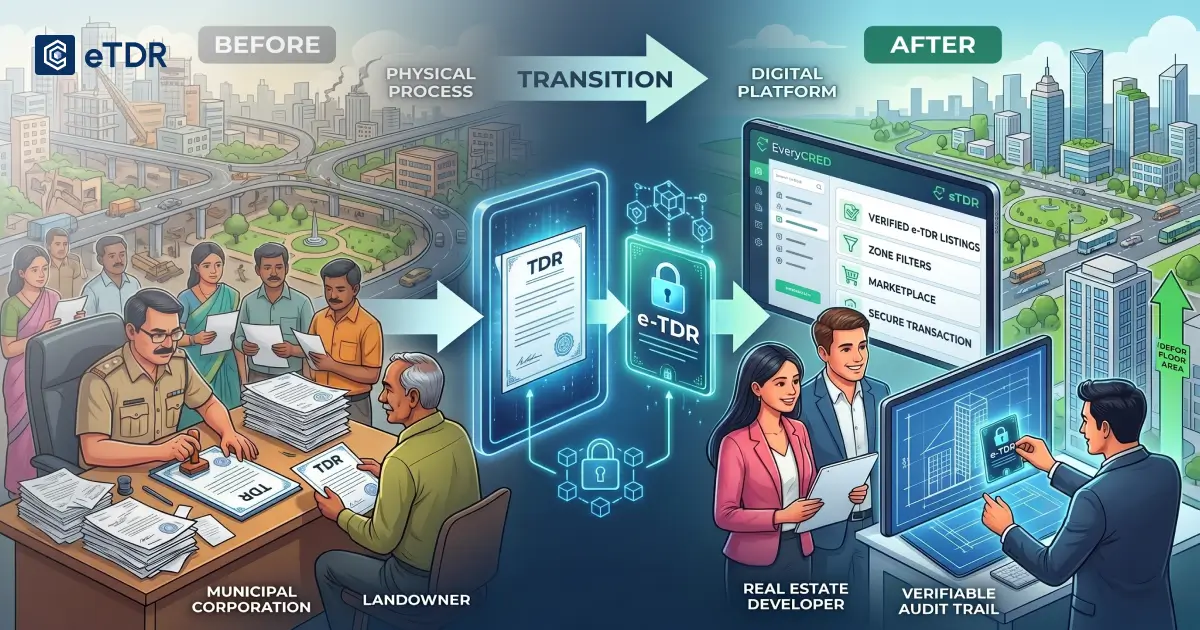
Urban expansion requires continuous land acquisition. Local governments must acquire privately owned land to build roads, parks, and public facilities. Paying cash compensation often strains municipal budgets. Authorities issue Transferable Development Rights (TDR) to solve this problem. These rights function as alternative compensation. They allow property owners to build additional floor space on their remaining property. Owners can also sell these rights to real estate developers.
The traditional management system relies entirely on physical paper certificates. This manual process creates long delays. It complicates verification procedures for municipal staff. It also exposes the system to forgery and lost documents. An online TDR marketplace changes this administrative process. It converts physical certificates into digital e-TDR units. This dedicated platform connects municipal corporations directly with real estate developers. The digital environment removes the need for physical intermediaries. It standardizes the trading process across different urban zones.
The Anatomy of a Digital Land Rights Exchange
An online TDR marketplace functions as a central registry and a secure trading platform. It removes physical paperwork from the land acquisition and real estate development process. The system operates on direct digital inputs and automated verifications.
- Certificate Generation: Municipal authorities complete the physical land acquisition. Authorized officials log into the portal. They enter the specific land dimensions and zone categories. The system automatically generates the digital development rights.
- Asset Listing: Landowners receive access to their digital accounts. They view their verified development rights. They list their available rights on the public portal for prospective buyers to review.
- Market Discovery: Real estate developers need additional floor space index for their projects. They access the online TDR marketplace. They filter available rights by zone, size, and price. Developers evaluate the fundamental variations in building allowances to ensure the rights apply to their specific project zones.
- Transaction Execution: The buyer and seller agree on the terms. They execute the transfer through the platform. The system updates the central registry immediately to reflect the new ownership.
The Lifecycle of a Digital Right from Generation to Consumption
Understanding the exact movement of an e-TDR clarifies the system’s efficiency. The process follows a strict linear path defined by municipal regulations.
- Initiation: The property owner surrenders land to the Urban Development Authority. The authority signs the physical surrender documents.
- Digitization: The municipal clerk inputs the surrender data into the database. The system issues the e-TDR to the citizen’s digital wallet.
- Holding Period: The citizen holds the digital asset securely. The asset cannot degrade or face destruction like a physical paper document.
- Transfer: A real estate developer purchases the right. The ownership transfers in the digital ledger. The original owner no longer has access to the digital asset.
- Utilization: The developer applies for building permissions. The developer submits the digital certificate to the municipal corporation to expand their building parameters.
- Retirement: The municipal corporation approves the building plan. The system marks the e-TDR as consumed. The asset is permanently retired and removed from public circulation.
Municipal Corporations Standardize Land Acquisition
Local governments face severe challenges in tracking physical development certificates. An online TDR marketplace provides Smart City Mission Teams and municipal bodies with real-time administrative oversight.
- Centralized Tracking: City planners monitor the exact volume of development rights issued across all city zones. They track how many rights actively circulate in the market at any given time.
- Fraud Prevention: Physical certificates allow for illicit duplicate submissions. Digital ledgers verify the unique identifier of every e-TDR. The system automatically blocks any attempt to reuse a consumed certificate.
- Value Capture Integration: The national guidelines on urban development funding from NITI Aayog emphasize using these rights for infrastructure financing. Digitization makes this financing method accountable and measurable for government auditors.
- Smart City Mandates: Implementing a digital infrastructure framework aligns local governance with national technology directives. It creates a data-driven environment for urban planning.
This shift enables municipal bodies to manage urban density with exact precision. They rely on concrete data rather than manual estimations.
Real Estate Developers Secure Verified Approvals
Developers require reliable sources for additional building rights to maximize their project scale. The physical certificate system involves manual verification steps that delay project timelines by months.
- Instant Verification: Developers check the authenticity of a certificate instantly on the platform. The system queries the municipal database to confirm the asset remains valid and unconsumed.
- Direct Procurement: Buyers negotiate and purchase directly from verified sellers. The online TDR marketplace eliminates unregulated brokers and opaque pricing structures from the procurement process.
- Project Certainty: Clear visibility into available rights allows developers to plan high-density commercial and residential projects with total certainty. They secure the exact square footage required before beginning construction.
- Approval Efficiency: The operational advantages for city planning extend directly to private developers. Verified digital certificates move through the building approval process faster than physical documents.
An online TDR marketplace creates a highly predictable procurement cycle for real estate firms operating in dense urban centers.
Transitioning Physical Assets to Digital Formats
Paper certificates deteriorate over time. They get lost in municipal archives. They face constant counterfeiting risks. Converting these physical documents into an e-TDR format secures the municipal asset base.
- Data Migration: Administrative teams input existing physical certificate details into the new municipal database. They scan the original documents for the permanent archive.
- Owner Authentication: The system verifies the identity of the original land owner using national identity databases. This ensures the digital asset goes to the correct legal entity.
- Digital Issuance: The platform generates a secure digital asset. It links this unit directly to the authenticated owner’s profile.
- National Standardization: The Ministry of Housing and Urban Affairs drives the push for digitization in urban infrastructure to standardize land records across all states.
This structured conversion process addresses the immediate requirement for Indian municipalities to audit and secure their historical land records.
Infrastructure Requirements for the Trading Portal
Building a functional online TDR marketplace requires specific technical foundations. The software must handle highly sensitive government data. It must also process high-value financial transactions without failure.
- Role-Based Access: The system requires distinct login protocols. Government officials, landowners, and developers require different permission levels within the portal to maintain security.
- Immutable Ledgers: A verifiable registry tracks every single change in ownership. Once a transaction occurs, the record cannot undergo alteration or deletion by any user.
- Automated Zoning Calculations: The platform calculates the exact square footage available based on complex, zone-specific municipal regulations.
- Secure Data Transfers: Implementing a standardized electronic transfer protocol ensures complete data integrity during the handover between buyer and seller.
The technical architecture supports concurrent users during high-demand periods. It maintains uptime during peak real estate transaction seasons.
Implementing Verifiable Digital Infrastructure
EveryCRED eTDR provides a verifiable credential system for municipal corporations and urban development authorities. Our platform digitizes paper certificates into cryptographically secure e-TDR units. It establishes an online TDR marketplace where real estate developers verify and acquire rights directly.
EveryCRED integrates with existing municipal databases to track the generation, transfer, and consumption of development rights in real time. The system prevents duplicate usage. It maintains a clear, automated audit trail for government oversight. Municipalities use this system to transition away from physical document management and establish strict control over their development rights inventory.
Contact us now for a demo.
The Future of Urban Density Management
Indian cities require efficient land acquisition methods to build the necessary public infrastructure. Transferable Development Rights facilitate this process without depleting municipal funds. Moving this system to an online TDR marketplace eliminates manual errors. It accelerates real estate approvals.
Urban planners maintain exact records of urban density and land use. Real estate developers access the building rights they need without administrative delays. Digitizing these assets into e-TDR formats creates a functional and transparent environment for organized city growth. The transition from paper to digital platforms secures the integrity of urban development across the country.
Leave a Reply