0Municipal corporations across India are changing how they manage land acquisition. Urban development requires space for roads, parks, and civic amenities. Governments issue Transferable Development Rights as compensation when they acquire private land.
A Transferable Development Right or TDR allows the landowner to build additional areas on another plot or sell the right to a real estate developer. Historically, municipal bodies issued physical certificates.
Today, urban planners use a digital TDR system to track these transactions. The transition to an e-TDR environment removes physical paperwork. It provides a secure database for municipal corporations and real estate developers.
Legacy Development Rights Systems Create Administrative Delays
Government departments struggle to maintain accurate physical ledgers. Paper certificates require manual verification. This process consumes administrative hours. Real estate developers experience delays when they purchase or apply these rights.
Administrative Bottlenecks
- City planners spend weeks authenticating physical documents.
- Manual ledgers increase the risk of duplicate certificate issuance.
- Property owners face long wait times to receive their compensation.
- Developers cannot easily verify the legal status of a certificate.
The Demand for System Updates
Municipal bodies require faster verification methods. Smart city initiatives depend on rapid infrastructure development. A digital TDR system solves these administrative bottlenecks. It places the entire lifecycle of a certificate into an online database.
National Policy Directs Municipalities Toward Technology Integration
The central government encourages cities to update their land valuation methods. Accurate land value capture funds public infrastructure. NITI Aayog guidelines outline the necessary steps for cities to monetize urban land effectively. The government views TDR as a primary tool for urban expansion.
Policy Directives for Urban Growth
- The central government advises states to digitize property records.
- Policies mandate clear compensation rules for land acquisition.
- Smart City Mission teams use digital tools to manage urban densification.
Urban planners must follow these guidelines to access federal funding. An e-TDR platform ensures compliance with national standards. It records every issuance and transfer in a central repository.
How a Digital TDR System Functions for Smart Cities
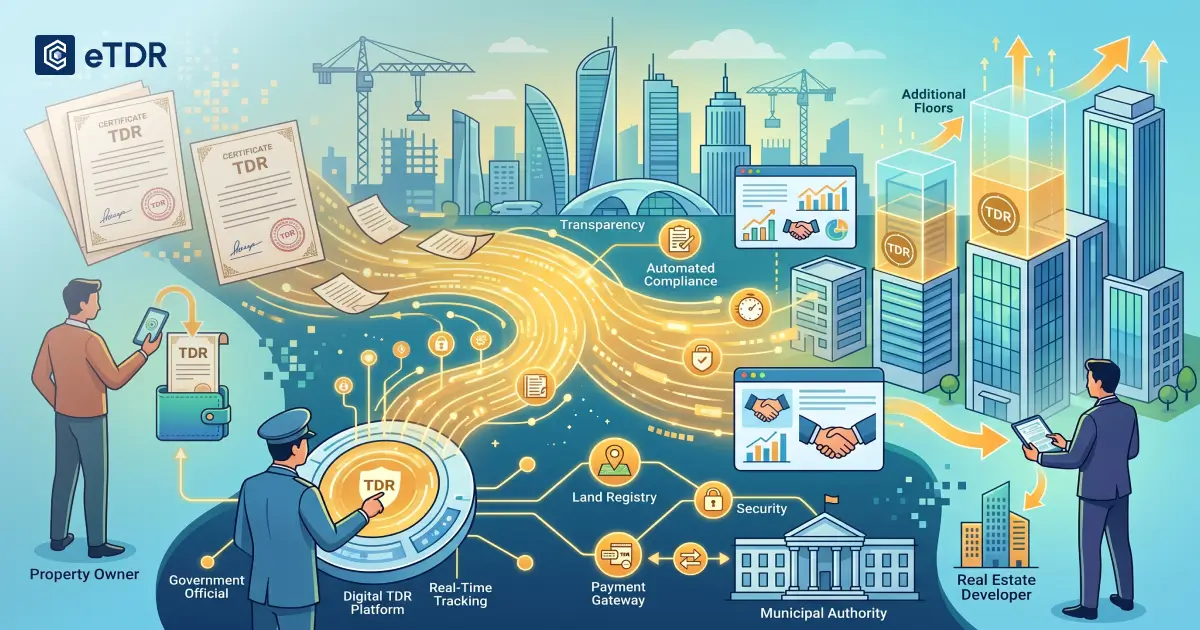
A digital TDR system connects property owners, developers, and government officials on a single platform. The software automates the issuance process.
Centralized Certificate Generation
- The municipal authority approves the land acquisition request.
- The software calculates the exact square footage owed to the owner.
- The system generates an electronic certificate.
- The property owner receives the certificate in a secure digital wallet.
Transaction and Transfer Protocols
Property owners sell these certificates to builders. The platform records this sale. It updates the ownership details immediately. Real estate developers use the platform to surrender the certificate to the government. The government approves the additional building height. You can observe how these specific automated compliance protocols secure the entire process from fraud.
Mumbai BMC Proves the Feasibility of Online Platforms
Large municipal corporations are currently deploying these systems. The Brihanmumbai Municipal Corporation recently launched an online portal for development rights. The Mumbai e-TDR platform launch requires users to complete mandatory Know Your Customer protocols.
Security Measures in Active Use
- The platform verifies the identity of all buyers and sellers.
- The system generates digital contract notes for every transaction.
- Municipal officials monitor the market prices in real time.
Other Indian cities are evaluating this implementation. Urban development authorities recognize the benefits of a regulated online market. The e-TDR software prevents unauthorized individuals from altering records.
Real Estate Developers Benefit from Transparent Markets
Real estate developers need a consistent supply of development rights to execute large projects. An opaque market limits their ability to plan construction. A digital TDR system creates a transparent marketplace.
Improved Market Liquidity
- Developers view available certificates on a public or semi public board.
- Standardized contracts reduce legal disputes between buyers and sellers.
- Pricing data becomes accessible to authorized participants.
Accelerated Project Timelines
Developers complete their purchases faster. They submit the digital certificate to the planning department with one click. The software verifies the certificate instantly. The municipality grants the building permit without manual file reviews. This speed aligns with the current urban planning trends that emphasize rapid smart city development.
Key Technological Requirements for e-TDR Infrastructure
Municipal corporations must select software that meets strict security standards. The platform must handle high volumes of data.
Database Architecture
- The system must use secure servers located within India.
- The database must record a timestamp for every user action.
- The architecture must support concurrent users during peak business hours.
Integration Capabilities
- The software must connect to the state land registry database.
- The platform requires integration with government payment gateways.
- The system must link to the municipal building permission software.
These technical requirements ensure the e-TDR environment remains stable. Authorities rely on this stability to govern smart city growth.
The Implementation Roadmap for Urban Authorities
Adopting a digital TDR system requires a structured approach. Municipalities cannot switch off the paper system overnight. They follow specific phases to deploy the software safely.
Phase One Assessment and Digitization
- The authority audits all existing paper certificates.
- Data entry teams input the active records into the new database.
- Officials verify the accuracy of the digitized records.
Phase Two Training and Deployment
- The municipality trains its town planning staff on the software.
- The authority conducts workshops for local real estate developers.
- The government launches the platform for new land acquisitions only.
Phase Three Full Integration
- The authority phases out the acceptance of paper certificates.
- All secondary market transfers occur exclusively on the platform.
- The system generates automated reports for the municipal commissioner.
Government Officials Gain Complete Oversight of Urban Density
City leaders need accurate data to manage infrastructure loads. A sudden concentration of building projects strains local water and electricity grids. A digital TDR system gives officials a clear view of where developers apply their rights.
Real Time Zoning Reports
- Planners see exactly which city wards receive the most development applications.
- The software flags areas approaching their maximum structural density.
- The municipality can temporarily halt the application of rights in overloaded zones.
Revenue and Taxation Audits
- The system calculates the exact transfer fees owed to the municipal corporation.
- Finance departments reconcile payments daily.
- Auditors review the digital logs to ensure total financial compliance.
This oversight prevents haphazard development. It allows smart city mission teams to direct growth toward supported areas.
Secure Urban Development with EveryCRED eTDR
Municipal corporations require specialized technology partners to build these platforms. EveryCRED provides a comprehensive digital TDR system designed specifically for Indian urban development authorities. The platform digitizes the entire lifecycle of Development Rights Certificates. The EveryCRED e-TDR solution uses cryptographic security to issue tamper proof verifiable credentials directly to property owners. The system integrates smoothly with existing municipal portals. It features automated contract generation and real time market analytics. Government departments use the software to eliminate forged documents and reduce application processing times. The platform ensures complete transparency for both city planners and real estate developers.
Conclusion
Urban expansion requires efficient land acquisition and compensation methods. Legacy paper processes delay critical infrastructure projects. Municipal corporations must modernize their approach to development rights. A digital TDR system provides the necessary infrastructure for this modernization. The shift to an e-TDR platform eliminates manual errors and speeds up verification. Real estate developers gain access to a transparent marketplace. Government authorities maintain strict control over urban density and compliance. Indian smart cities will rely on these secure platforms to manage sustainable growth. The integration of this technology marks a fundamental improvement in municipal governance.
Leave a Reply