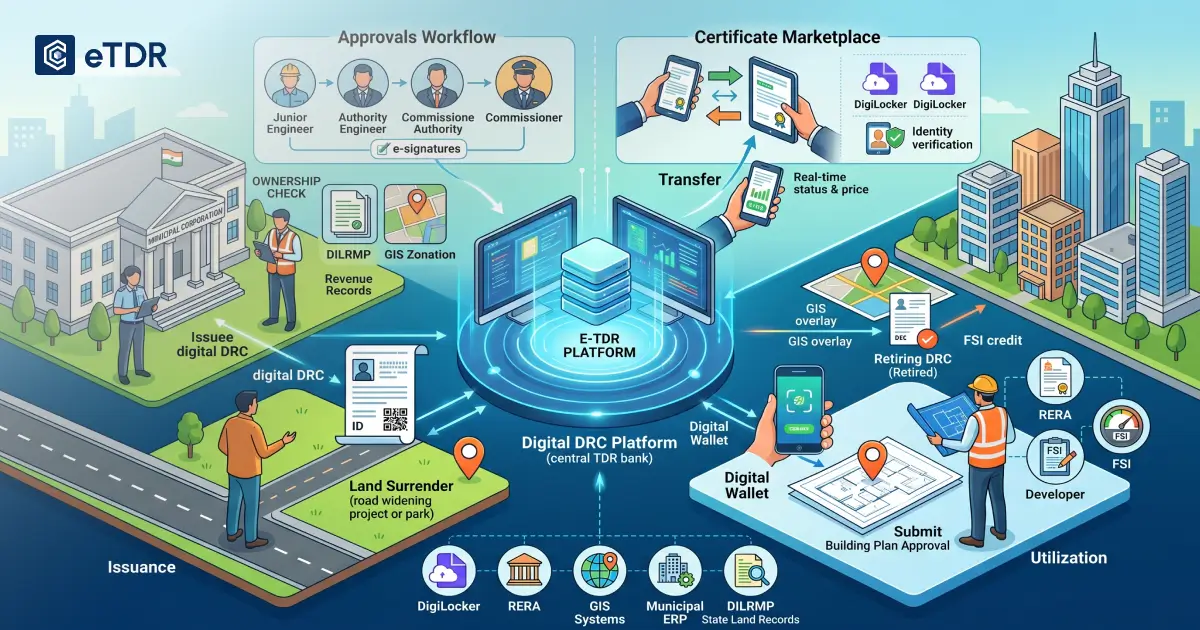
When a city acquires private land for a road widening, a park, or a public amenity, it issues a Development Rights Certificate (DRC) to the landowner as compensation. That certificate holds real monetary value. The landowner can use it to build additional floor space elsewhere in the city, or sell it to a developer who needs the FSI credit.
Managing those certificates is the direct responsibility of Municipal Corporations and Urban Development Authorities. How that management is structured determines whether TDR works as a policy tool or becomes a source of fraud, disputes, and stalled approvals.
This guide covers what a development rights certificate management system must govern, how responsibilities are distributed across stakeholders, what compliance checks are required at each stage, and why digital infrastructure is the only scalable path forward.
Certificate Management Covers More Than the Issuance Stage
A common assumption is that certificate management ends once a DRC has been issued. It does not.
Development rights certificate management covers the full lifecycle of every certificate from land identification to final utilisation. A functional system handles:
- Certificate creation with verified land parcel data
- Multi-level approval workflows with documented sign-offs at each stage
- Unique identification and security of each certificate against duplication
- Transfer registration between holders and buyers
- FSI credit tracking against active building approvals
- Real-time certificate status for all authorised parties
- Verification access for courts, banks, and planning teams
When any one of these functions fails, the entire TDR programme is affected. The depth of a city’s TDR management system determines whether its certificates are trusted by the market and compliant under audit.
Six Certificate States Every Municipal Corporation Must Monitor
A DRC does not exist in just two states. It moves through at least six distinct stages, and each transition requires a specific governance action.
- Pending: Application submitted; verification in progress
- Issued: DRC created, signed, and assigned to the certificate holder
- Active: Certificate is live in the market, available for transfer or utilisation
- Blocked: Certificate is under legal dispute, compliance review, or administrative hold
- Transferred: Ownership has moved from the original holder to a new party
- Utilised/Retired: DRC has been applied to a building approval and permanently closed
City planners depend on this data to understand how much FSI credit is in circulation at any given moment, which zones face supply pressure, and where development activity is concentrated. Without live state tracking, the TDR bank produces no actionable data for planning decisions.
Governance Requires Clear Role Boundaries Across Four Groups
A development rights certificate management system assigns specific authority to specific roles. Without defined boundaries, approvals slow down and accountability gaps form.
Municipal Corporations and Urban Development Authorities
- Identify land parcels for public purpose and initiate DRC creation
- Run multi-level approvals from Junior Engineer to Commissioner
- Maintain the central TDR bank and monitor citywide FSI distribution
Town Planning and Revenue Officers
- Verify land ownership, encumbrances, and zone classification
- Confirm receiving area eligibility before FSI credits are calculated
- Approve documentation before issuance is finalised
Certificate Holders (Landowners)
- Access DRCs through a digital wallet or portal
- List certificates for sale or submit them for utilisation
- Track transfer status and ownership history in real time
Developers and Third-Party Verifiers
- Search active certificates by zone and area requirement
- Submit DRCs as part of building plan approval filings
- Verify certificate authenticity via QR code or unique ID for loan or legal purposes
How each role interacts with the platform in practice determines how smoothly these handoffs work at the point of building approval.
The Compliance Checks Built Into Every Certificate Stage
Each stage of the development rights certificate management system requires specific compliance enforcement. A digital system runs these automatically. A paper system depends on manual checks that introduce delays and errors.
At Issuance:
- Land parcel data must match official revenue records
- Surrender documentation must be registered and encumbrance-free
- Zone classification must be confirmed before DRC area is calculated
- E-signatures are required at each stage of the approval chain
The national TDR guidelines from NITI Aayog specify that DRC issuance must be backed by registered land surrender documentation as a national compliance baseline for every issuing authority.
At Transfer:
- Certificate must be in Active status before a transfer can proceed
- Buyer and seller identities must be verified through official channels
- Zone eligibility of the receiving plot must be confirmed before the transaction clears
- Transfer records must include timestamps and both party identifiers
At Utilisation:
- DRC must not be partially or fully utilised in another building file
- Receiving plot must fall within an approved receiving zone
- FSI credit applied must not exceed the certificate’s remaining area
- A digital utilisation record is generated as part of the building approval file
The direct impact on approval timelines and fraud reduction from automating these compliance steps is measurable from the first stages of implementation.
Five Integration Points That Make Certificate Verification Reliable
A development rights certificate management system cannot operate in isolation. It must connect to existing government infrastructure to enforce compliance accurately.
- DigiLocker: Identity verification for certificate holders and buyers
- RERA Portal: Developer registration and project compliance checks
- GIS Systems: Zone classification and land parcel boundary confirmation
- Municipal ERP: Approval synchronisation, billing, and cross-department record alignment
- State Land Records (DILRMP): Cross-referencing ownership and encumbrance data before issuance
Research on TDR programmes in India by the World Bank identifies fraud prevention and market transparency as conditions for DRCs to function as bankable instruments. Both depend on the certificate system drawing on verified external data, not only its own internal records.
Interoperability built on open standards such as W3C Verifiable Credentials also makes it possible for an e-TDR certificate issued by one municipal body to be verified by any other authority using the same infrastructure. This matters for cross-city TDR operations, which are increasingly common as development projects span administrative boundaries.
Paper-Based Systems Have Structural Limits That Administration Cannot Fix
India’s urban development pace has outgrown what manual TDR certificate management can handle. The failures of paper-based systems are structural, not administrative.
- Physical DRCs can be forged or submitted across multiple building approvals simultaneously
- No paper registry can confirm live certificate status across the city in real time
- Pricing depends on brokers because market data is invisible to most participants
- Manual verification delays building approvals by days or weeks regardless of staffing
These problems persist regardless of how many officers are assigned to manage the process. The limitations of paper TDR are inherent to the medium. Better administration cannot overcome them.
A digital e-TDR certificate management system addresses each failure at the process level. Blockchain anchoring makes records tamper-proof. Automated compliance checks replace manual cross-referencing. Transparent marketplace data removes broker dependency. QR-based verification replaces office visits.
The technical infrastructure for end-to-end e-TDR is built and operational. India’s Smart City Mission and the National Urban Digital Mission have established the broader digital governance framework. A development rights certificate management system built on open standards plugs directly into that infrastructure. For a clearer picture of what smart city-aligned TDR platform adoption looks like across municipal and planning teams, the implementation requirements are more straightforward than most authorities assume.
EveryCRED eTDR: A Platform Built for Certificate Governance
If your organisation is responsible for managing Development Rights Certificates, we have built EveryCRED eTDR specifically for this purpose.
We issue DRCs as W3C Verifiable Credentials anchored on blockchain. We manage all six certificate states, from Pending through Utilised, across every zone in the city through a central TDR bank. We run configurable multi-level approval workflows from Junior Engineer to Commissioner, with e-signatures recorded at each stage.
Our platform includes a regulated marketplace for direct TDR transactions, a GIS-based city map view with zone and parcel data, and instant QR-based verification for developers, courts, and banks. We integrate with DigiLocker, RERA, GIS systems, and existing municipal ERP software. Certificates issued on our platform are interoperable across municipal and state boundaries.
If your authority is currently managing TDR certificates through paper files or disconnected systems, contact EveryCRED eTDR to see the development rights certificate management system in a working demo.
Conclusion
A development rights certificate management system is the administrative backbone of any TDR programme. It determines whether certificates are trusted, whether transfers are clean, whether approvals are fast, and whether planning teams have the data they need. The national policy direction supports digital certificate management. The infrastructure to deliver it is available. The decision every Municipal Corporation and Urban Development Authority faces is whether their current system is equipped to meet the demands of a growing city’s development rights programme.
Leave a Reply