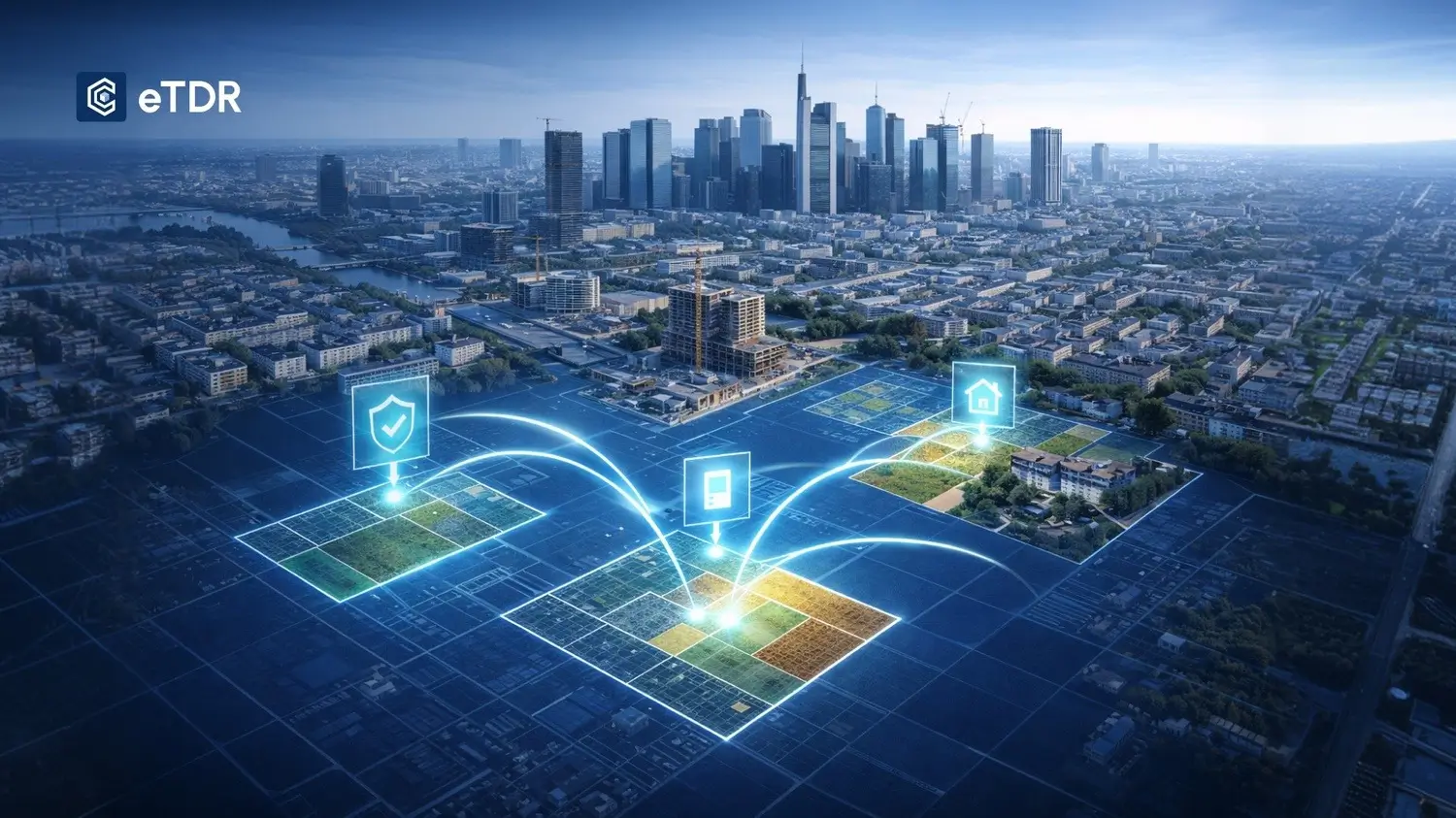
If you work in urban planning, real estate development, or government infrastructure, you have almost
certainly dealt with Transferable Development Rights (TDR). And if you have, you know the frustrations
of paper certificates, opaque pricing, slow verification, and the ever-present risk of fraud.
eTDR is the answer to all of that. In this guide, we break down exactly what eTDR is, why it was
created, and how it works — in plain language, without the jargon.
eTDR Full Form: What Does eTDR Stand For?
The eTDR full form is Electronic Transferable Development Rights. Three words that tell the whole story:
Put it together: eTDR is a digital system that converts traditional paper-based development rights into
secure, verifiable, instantly transferable digital credentials.
First, What is TDR?
To understand eTDR, you need to understand TDR. When a government needs land for a public purpose —
a road, a park, a school, a drainage project — it sometimes cannot or does not pay the landowner in cash.
Instead, it issues a Development Rights Certificate (DRC).
A DRC is essentially a voucher. It says: “You surrendered X square metres of land. In return, you
are entitled to build X square metres of additional floor space somewhere else — or sell that right to
someone who needs it.”
The concept is sound. Governments fund public infrastructure without cash outflows. Landowners receive
real economic value. Developers who need extra FSI can buy DRCs from landowners who do not need them.
The problem is in the execution — specifically, in how TDR has been managed on paper.
The Problem With Paper-Based TDR
Here is what actually happens when TDR runs on paper and manual processes:
- Fraud is rampant. Physical DRCs are documents. Documents can be forged, duplicated, and sold multiple times to different buyers. In markets where a single DRC can be worth crores, the incentive to commit fraud is significant.
- Pricing is opaque. There is no central marketplace. Prices are negotiated privately through brokers, and the same DRC in the same zone can transact at wildly different values. Landowners consistently receive below-market rates.
- Verification is painfully slow. When a developer wants to use TDR in a building approval, someone has to physically verify the DRC — check it against records, confirm it has not already been used. This takes weeks.
- Small stakeholders get locked out. Individual flat owners, small landowners — the very people who most need access to the TDR market — cannot navigate the broker-dependent, bureaucracy-heavy process.
These are not edge cases. They are the everyday reality of paper-based TDR in most cities.
What eTDR Does Differently
eTDR solves each of these problems at the root:
-
1
Fraud-proof credentials. Instead of a paper certificate, a DRC is issued as a blockchain-backed digital credential — cryptographically unique, impossible to duplicate, and permanently traceable.
-
2
Transparent pricing. A live digital marketplace lists available DRCs with transparent pricing, so buyers know exactly what the market rate is before they enter a transaction.
-
3
Instant verification. Any authorised party can verify a DRC in seconds — one click confirms authenticity, ownership, utilisation status, and zone eligibility.
-
4
Accessible to all. Any registered participant — whether a large developer or an individual landowner — can transact directly through the platform, without intermediaries.
How eTDR Works: The Simple Version
The eTDR system manages three things:
Why eTDR Matters Right Now
Cities across India are modernising their urban development infrastructure. TDR programs that were
designed to be efficient policy tools have been undermined for years by the limitations of paper-based
systems. eTDR is not a distant future concept — it is a live, deployable solution that cities and
urban bodies can adopt today.
The benefits are concrete:
- Fraud eliminated through blockchain-anchored credentials
- Approvals faster with instant digital verification
- Markets fairer with transparent, real-time pricing
- Governance stronger with immutable audit trails
How EveryCRED Helps You Implement eTDR
Knowing what eTDR is and actually running one are two different things.
EveryCRED is an eTDR solution provider that handles the entire implementation — from setting up your
digital DRC issuance process to building the marketplace where buyers and sellers transact, to making
verification instant for your team.
- No need to rebuild your existing systems.
- No need for a new IT department.
- You bring the mandate and the stakeholders — EveryCRED brings the platform.
Cities, urban bodies, and real estate organisations that have been stuck with slow approvals, fraud complaints,
and broker-dependent markets use EveryCRED to go fully digital — without the complexity that usually comes with it.
Want to see if eTDR is the right move for your organisation?
Leave a Reply