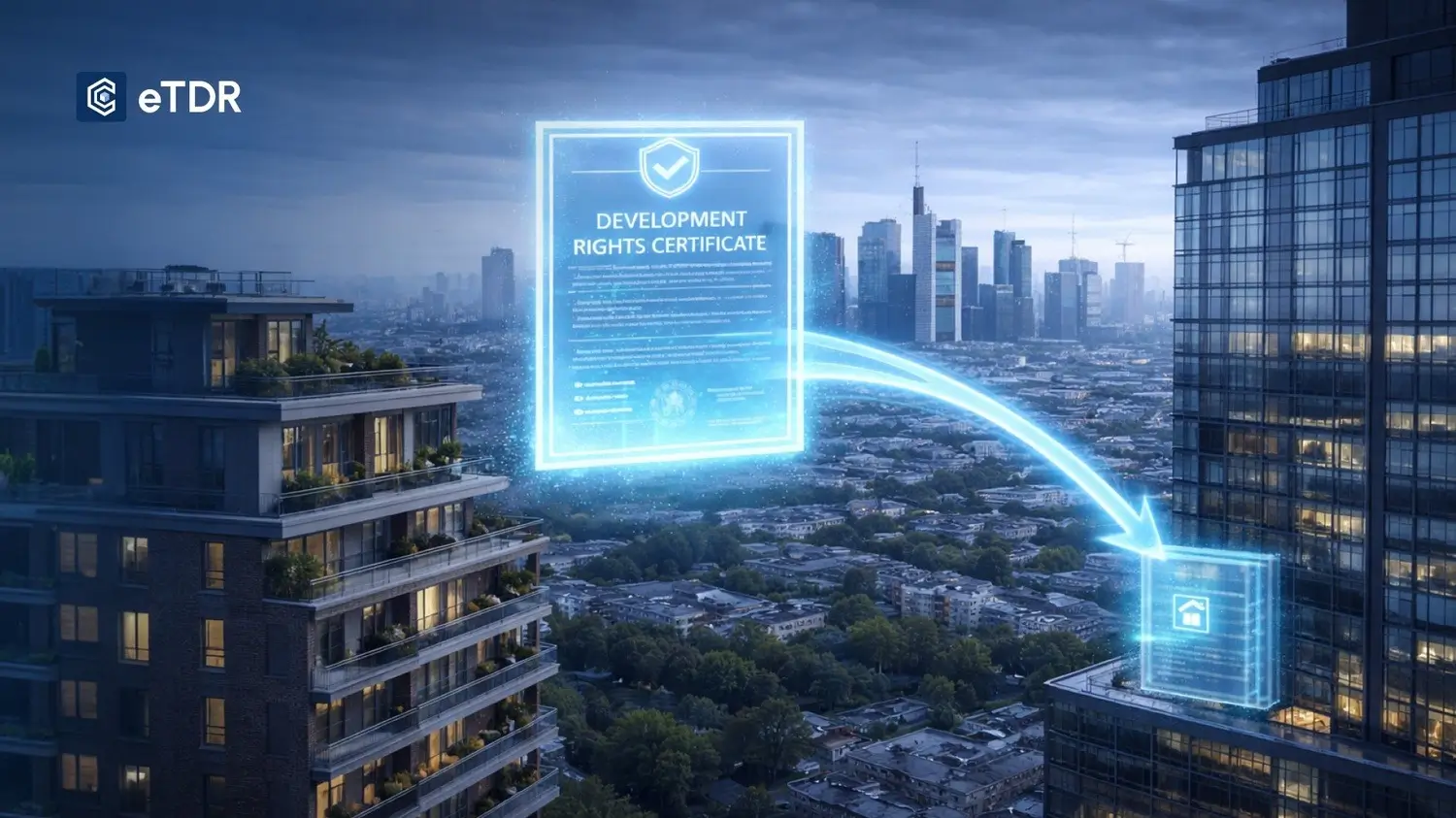
Cities grow. Roads get widened. Parks get built. Schools, drainage systems, and public amenities expand into land that is currently privately owned. And when that happens, governments face a fundamental question: how do you fairly compensate the landowner without draining the public treasury?
One of the most elegant answers urban planners have come up with is TDR — Transferable Development Rights. If you have encountered this term in a real estate transaction, a planning document, or a government notification and wondered what it actually means, this guide is for you.
TDR Full Form: What Does TDR Stand For?
The TDR full form is Transferable Development Rights. Breaking it down:
Put together: TDR is a legal instrument that gives a landowner the right to build additional floor space — not necessarily on their own surrendered land, but on another eligible plot — or to sell that right to someone else who needs it.
Why Does TDR Exist? The Problem It Solves
To understand TDR, you need to understand the problem it was designed to solve. When a city needs to widen a road, it often needs to acquire strips of privately owned land that fall within the proposed road alignment. The traditional approach is direct cash compensation — the government pays the landowner the market value of the land and acquires it.
This works, but it has serious limitations. Land acquisition is slow, legally contentious, and expensive — especially in dense urban areas where land values are high. In a rapidly growing city with hundreds of infrastructure projects running simultaneously, the cash outlay required is simply not sustainable.
TDR offers an alternative: instead of paying cash, the government gives the landowner the right to build additional floor space elsewhere in the city — or to sell that right to a developer who needs it.
The landowner gets real economic value. The government avoids a large upfront cash payment. And the city gets the infrastructure it needs. When it works well, TDR is a win for all three parties.
Key Terms You Need to Know
Understanding TDR requires knowing four terms that appear in every TDR transaction:
How TDR Works: A Practical Example
Consider a simple scenario.
A landowner in Mumbai owns a plot along a road that the municipal corporation wants to widen. A 30 square metre strip of her land falls within the road widening alignment. She surrenders that strip to the city. In return, the municipal authority issues her a DRC for 30 square metres. This DRC is now her asset.
She has two choices:
-
A
Use it herself. If she owns another plot in a designated TDR receiving zone, she can use the DRC to build 30 square metres of additional floor space on that plot — beyond what her base FSI permits.
-
B
Sell it. She can sell the DRC to a developer who needs extra FSI for their project. The developer pays her a market price, receives the DRC, and uses it to unlock additional buildable area on their development site.
Where Is TDR Used?
TDR is used globally as an urban planning instrument, but it is particularly significant in Indian cities — especially Mumbai, where it is embedded in the Development Control and Promotion Regulations (DCPR 2034) as a core mechanism for funding public infrastructure.
In Mumbai’s context, TDR is issued for:
- Road widening — Landowners who surrender strips for road projects
- Reservations — Plots reserved for public amenities (parks, schools, health centres) in the Development Plan
- Heritage conservation — Owners of heritage-listed properties who are restricted from redeveloping
- Slum Rehabilitation — Under Slum Rehabilitation Authority (SRA) schemes
Other Indian cities — Pune, Hyderabad, Bengaluru, and others — have adopted TDR frameworks of their own, each with varying rules on sending zones, receiving zones, and applicable FSI multipliers.
Limitations of Traditional TDR
The concept of TDR is sound. The implementation, however, has been deeply flawed in most cities — primarily because TDR has traditionally been managed on paper, through manual processes, and without any central marketplace.
The result:
- Rampant fraud through forged or duplicate DRCs
- Opaque pricing driven by brokers with information advantages
- Slow manual verification that delays building approvals
- A market effectively inaccessible to small landowners and individual stakeholders
These are not minor operational issues. They are structural failures that have consistently undermined the value TDR should deliver to the landowners, developers, and cities it was designed to serve.
TDR and eTDR: The Natural Next Step
Understanding TDR makes it immediately obvious why digitising it is not optional — it is essential. The paper-based limitations of TDR are not problems that better administration can solve. They are inherent to the medium: paper can be forged, manual processes are slow, and information asymmetry is inevitable without a central marketplace.
That is exactly what eTDR — Electronic Transferable Development Rights — addresses. By converting DRCs into blockchain-backed digital credentials, creating a transparent digital marketplace, and automating verification, eTDR transforms a well-intentioned policy tool into one that actually delivers on its promise.
How EveryCRED Is Solving the TDR Problem
TDR was always a good idea. The paper-based system it runs on is not.
If your city, organisation, or real estate project is dealing with slow DRC verification, pricing disputes, fraud complaints, or approval backlogs — those are not process problems. They are symptoms of a system that was never built for the scale and transparency modern urban development demands.
EveryCRED works with cities and urban bodies to replace that broken system with a fully digital eTDR platform — where DRCs are issued digitally, transactions happen in real time, and verification that used to take weeks takes seconds.
- No more chasing paper certificates.
- No more depending on brokers for pricing.
- No more building approvals stuck in manual queues.
If you are responsible for managing or participating in a TDR program and the current process is costing you time, money, or trust — EveryCRED is worth a conversation.
Leave a Reply